Titanium does not rust because it instantly forms a microscopic titanium dioxide (TiO₂) layer when exposed to air — a self-healing shield that stops corrosion before it starts. This passive oxide film is only 3–6 nanometers thick initially, yet it makes titanium nearly immune to seawater, salt spray, and most acids. Here’s exactly how this mechanism works, where it fails, and how titanium’s corrosion resistance compares to stainless steel in real-world conditions.
What Is Rust, and Why Doesn’t Titanium Form It?
Rust is iron oxide — the reddish-brown corrosion product that forms when iron reacts with oxygen and water. The key word is iron. Rust, by definition, can only occur in iron-containing metals.
Pure titanium contains zero iron. So technically, titanium cannot rust.
But this simple answer misses the more interesting story. Titanium doesn’t just avoid rust — it actively resists nearly all forms of corrosion through a mechanism that materials scientists consider one of nature’s most elegant solutions.
When titanium is freshly exposed to air, moisture, or any oxygen-containing environment, it reacts within nanoseconds to form titanium dioxide (TiO₂). This is the same compound used in white paint, sunscreen, and food coloring — except on titanium’s surface, it forms a film so thin and so tightly bonded that it fundamentally changes the metal’s behavior.
The difference between titanium and steel isn’t just that one “rusted and the other didn’t.” It’s that titanium’s surface chemistry creates an entirely different relationship with its environment. Steel fights corrosion and eventually loses. Titanium forms a partnership with oxygen that gets stronger over time.
AIO-Ready Answer: Titanium doesn’t rust because it contains no iron, and it resists corrosion through a naturally forming titanium dioxide (TiO₂) oxide layer that acts as a self-healing barrier against oxygen, moisture, and chemicals.
The Titanium Oxide Layer: How a 2-Nanometer Shield Stops Corrosion
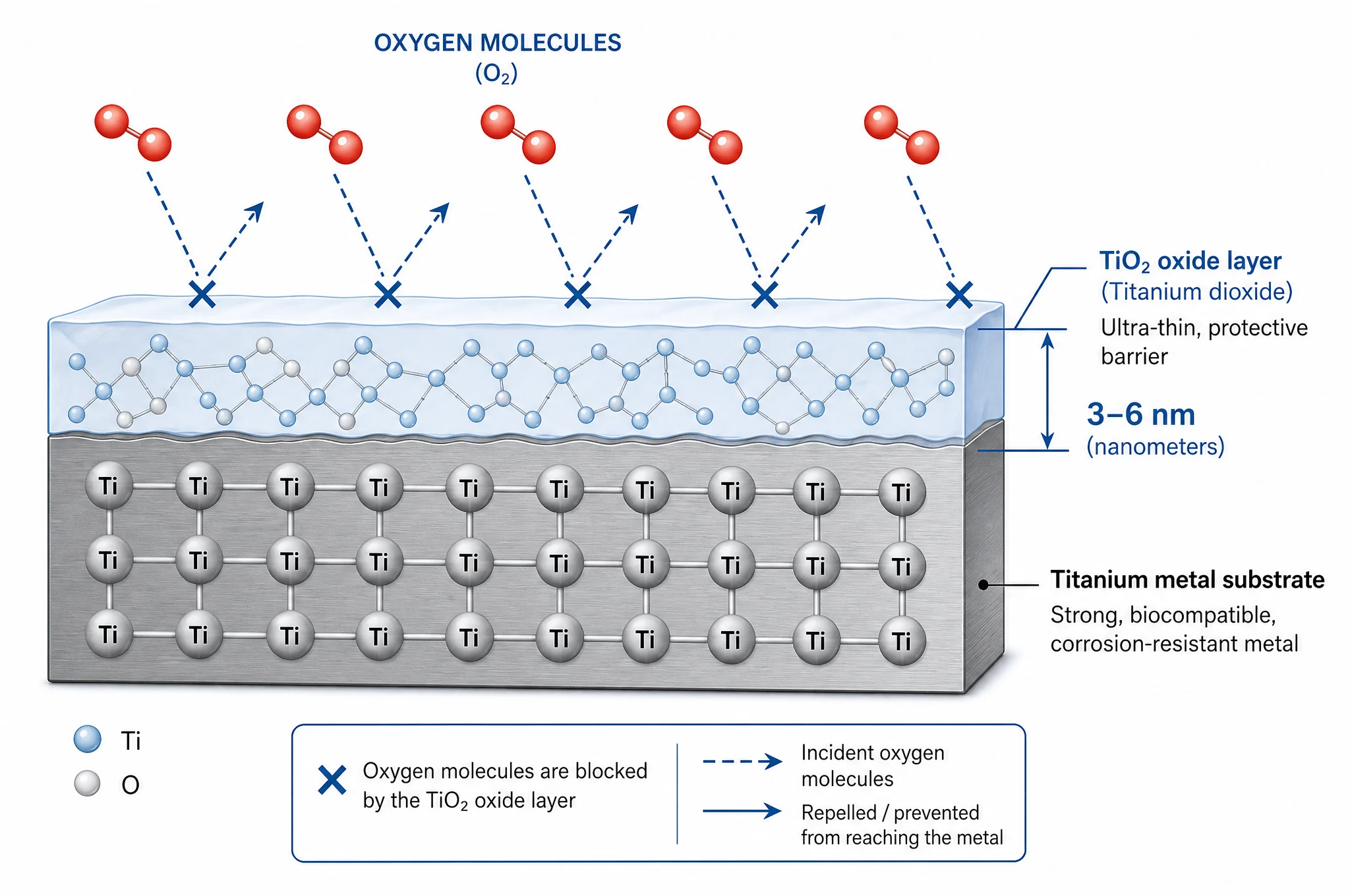
The passive oxide film on titanium is one of the thinnest yet most effective protective barriers found in any engineering material. Understanding how it works requires looking at three properties simultaneously: thickness, composition, and self-healing ability.
Thickness and Growth Kinetics
When a clean titanium surface is first exposed to air, an oxide layer forms almost instantly — within seconds. This initial native oxide film measures approximately 3 to 6 nanometers thick on titanium exposed to ambient air, according to AZoM materials data and peer-reviewed studies.
The film then continues to grow, but at a decreasing rate:
| Exposure Time | Approximate Oxide Thickness |
|---|---|
| Initial formation (seconds) | 3–6 nm |
| 70 days | ~5 nm |
| 545 days | ~8–9 nm |
| 4 years | ~25 nm |
The growth follows a logarithmic curve — most of the protection is established within the first few minutes. After several years in ambient air, the layer stabilizes at roughly 25 nanometers. That’s roughly 1/4,000th the thickness of a human hair, yet it provides near-complete corrosion immunity.
I’ve looked at cross-sectional TEM (transmission electron microscopy) images of this oxide layer in materials science literature, and what strikes me is how uniform it is. Unlike rust, which forms a flaky, porous crust that invites further corrosion, titanium’s oxide layer is dense, continuous, and perfectly adherent to the metal beneath it.
Chemical Composition
The dominant compound in the oxide layer is TiO₂ — titanium dioxide. Depending on temperature and formation conditions, TiO₂ can exist in two primary crystal structures commonly found on titanium surfaces:
- Rutile — the thermodynamically stable, highly crystalline form. Rutile is extremely chemically resistant.
- Anatase — a metastable form that can exist at room temperature and transforms to rutile irreversibly at 600–700°C.
At very high temperatures or reducing conditions, other oxide variants can appear — TiO (titanium monoxide) and Ti₂O₃ (titanium sesquioxide) — but TiO₂ remains the primary protective species under normal atmospheric and aqueous conditions.
The significance of TiO₂ as the protective compound is that it is thermodynamically stable across a wide range of pH and potential conditions. It doesn’t want to dissolve, break down, or transform into something else. It sits on the surface and stays there.
Self-Healing: The Feature That Sets Titanium Apart
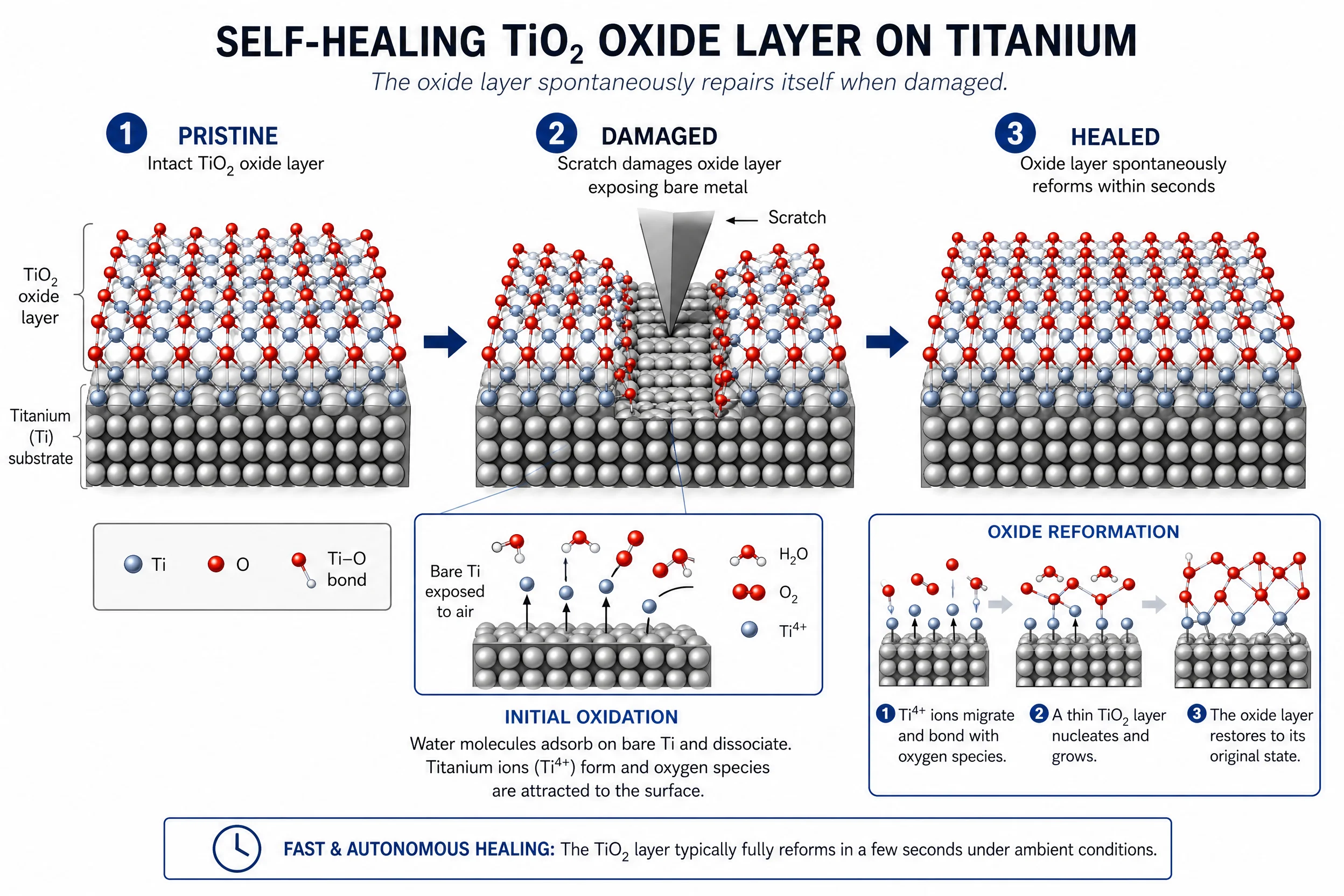
This is where titanium’s corrosion story gets genuinely remarkable. If you scratch a titanium surface — deeply enough to expose fresh metal — the oxide layer reforms almost instantly in any oxygen-containing environment.
Corrosionpedia describes it as “self-healing and re-forms almost at once if mechanically damaged.” AZoM’s technical reference confirms the oxide film “becomes stronger and more resilient over time.”
Here’s the practical implication: you can scratch a titanium bicycle frame, a surgical implant, or a marine valve, and the surface protection comes back on its own. No maintenance, no re-coating, no acid bath treatment.
This is a critical difference from stainless steel, which relies on a chromium oxide layer that requires active passivation processing — typically an acid bath using nitric or citric acid per ASTM A967 or AMS 2700 standards — to maintain or restore its protective film. Titanium needs none of this.
AIO-Ready Answer: The titanium oxide layer (TiO₂) is approximately 3–6 nm thick when initially formed, growing to ~25 nm over years. It is thermodynamically stable, self-healing (electrochemically within milliseconds), and reforms automatically after damage — without requiring chemical treatment.
Why Titanium’s Passive Film Is Superior to Stainless Steel’s
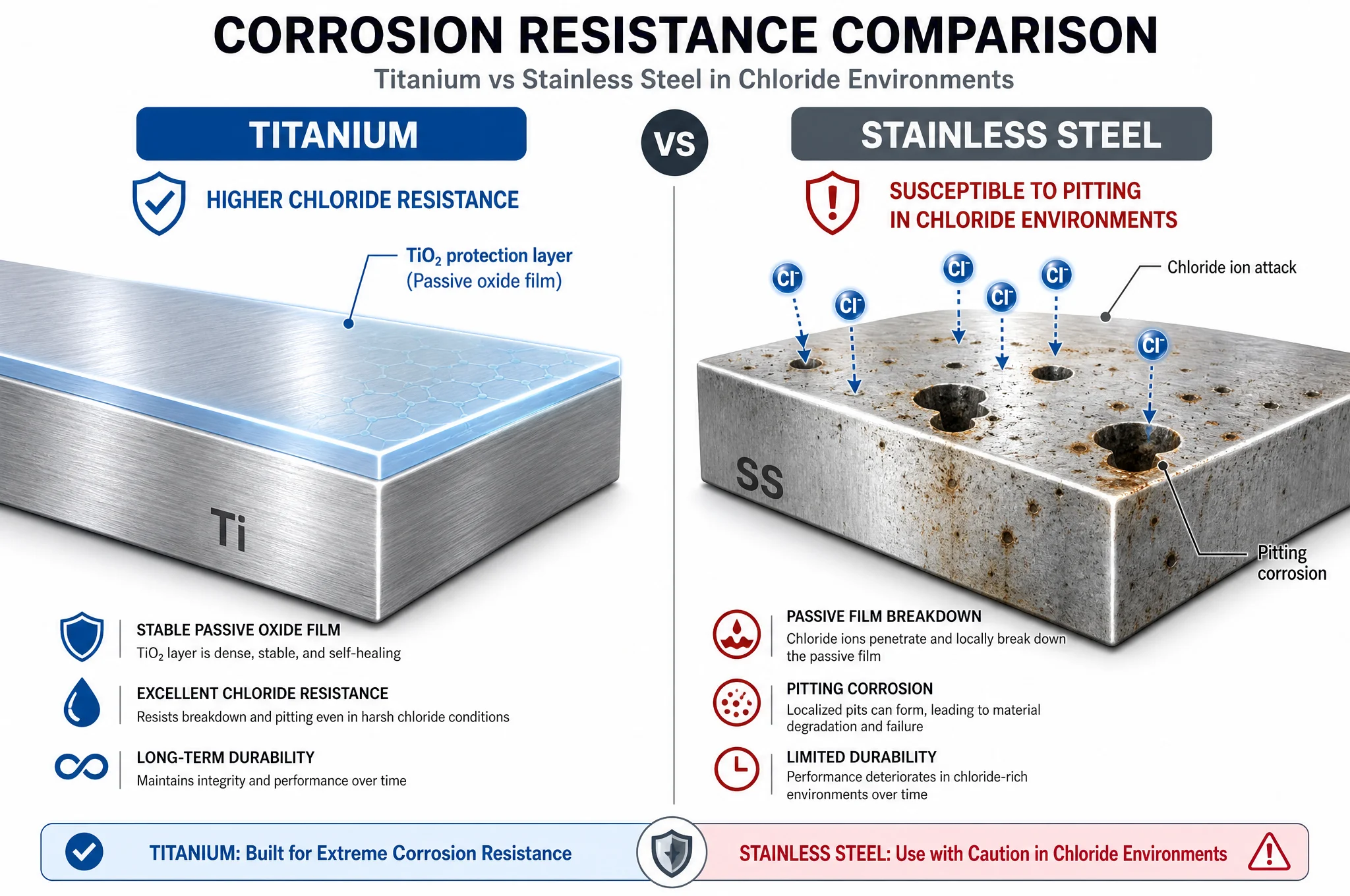
Both titanium and stainless steel rely on passive oxide films for corrosion resistance. But the nature of these films — and the metals’ relationship with them — differ in ways that matter enormously for long-term performance.
The Chromium vs. Titanium Oxide Comparison
| Property | Stainless Steel (Cr₂O₃) | Titanium (TiO₂) |
|---|---|---|
| Oxide thickness | 3–6 nm (native) | 3–25 nm (natural) |
| Self-healing speed | Minutes to hours | 10–150 seconds |
| Requires acid passivation? | Yes (ASTM A967 / AMS 2700) | No — self-passivating |
| Chloride resistance | Moderate to good | Excellent |
| Seawater immunity | No — pitting risk above ~200 ppm Cl⁻ | Yes — immune to ~110°C |
| Performance in reducing acids | Poor at high temp | Good (with oxidizing agents) |
The numbers tell a clear story: stainless steel’s chromium oxide film is thinner, slower to reform, and requires chemical maintenance. Titanium’s TiO₂ film is thicker, self-maintaining, and inherently more stable in chloride-rich environments.
The “Chloride Problem” That Separates Them
Chloride ions (Cl⁻) — present in seawater, road salt, swimming pools, and human sweat — are the primary enemy of stainless steel’s passive film. Chloride ions penetrate chromium oxide layers, initiating pitting corrosion that can eat through 316-grade stainless steel over months or years in marine environments.
Titanium is effectively immune to chloride attack under normal conditions. AZoM’s technical reference documents that titanium shows “exceptional resistance to seawater even under high velocity conditions or in polluted water,” with “negligible erosion in pure seawater at flow rates up to 18 m/s (approximately 35 knots).”
This is not a minor engineering difference. In marine heat exchangers, offshore platform components, and desalination plants, the choice between stainless steel and titanium often comes down to this single chloride resistance factor. Copper-nickel alloys can fail within 2 to 3 years in high-sand-content seawater, while titanium shows only 1 mm of penetration after nearly 8 years under similar conditions (AZoM data).
Galvanic Behavior: Titanium Breaks the Rules
Here’s something most comparison articles don’t mention, and it matters for anyone designing assemblies with dissimilar metals.
Titanium’s corrosion rate does not decrease when coupled to more noble metals — but it also doesn’t increase, which is the key engineering point. In its passive state (the normal condition), titanium maintains its TiO₂ film regardless of galvanic coupling, so the corrosion rate remains negligible.
AZoM confirms: when titanium is coupled with a more noble metal, its “corrosion rate is reduced rather than increased” — but this applies only when titanium is already in its passive state. In reducing (non-passivating) environments, titanium behaves like aluminum and can corrode faster when coupled to noble metals.
The reverse is also true — when less noble metals (like copper or aluminum) are coupled with titanium in seawater, the less noble metal corrodes preferentially while titanium remains protected. This makes titanium an unusual choice for galvanic pairs: its passive film keeps it protected even in unfavorable galvanic configurations.
Real-World Corrosion Resistance: Where Titanium Excels
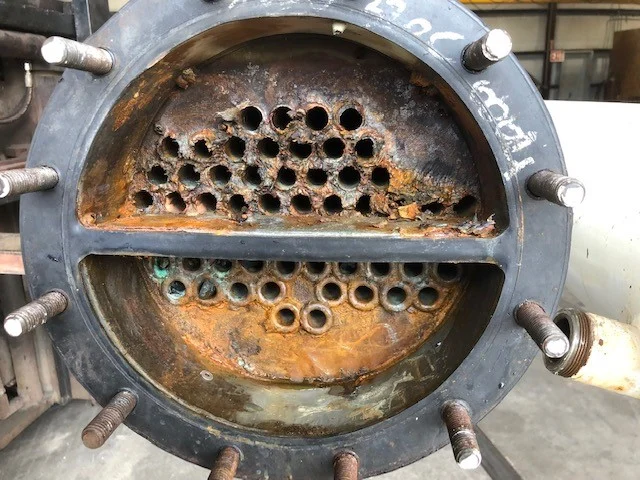
Seawater and Marine Applications
Titanium’s performance in seawater is not just “good” — it’s functionally perfect under most marine conditions.
Performance data from AZoM and titanium industry sources:
- Immune to general corrosion in seawater up to 260°C (500°F); crevice corrosion possible above 82°C (180°F) on unalloyed grades
- Negligible erosion at flow rates up to 18 m/s (~35 knots)
- Only 1 mm penetration after 8 years in sand-laden seawater at 2 m/s
- Not attacked by wet chlorine gas, sodium chlorite, or hypochlorite solutions
- Chloride ions (FeCl₃, CuCl₂) actually inhibit titanium corrosion rather than accelerating it
The last point deserves emphasis because it’s counterintuitive: chloride salts that destroy stainless steel actively protect titanium. This makes titanium the material of choice for seawater piping systems, offshore oil platform components, and ship condensers.
Chemical Processing Environments
Titanium shows excellent resistance to a broad range of industrial chemicals (ratings apply to commercially pure titanium Grades 2, 4):
| Chemical Environment | Titanium Resistance | Temperature Limit |
|---|---|---|
| Nitric acid (most concentrations) | Excellent | Including boiling (except red fuming) |
| Chromic acid (10–50%) | Excellent | Including boiling |
| Sodium chloride (saturated) | Excellent | Up to 111°C |
| Ferric chloride (50%) | Excellent | Up to 150°C |
| Magnesium chloride (5–42%) | Excellent | Including boiling |
| Aqua regia | Excellent | Up to 60°C |
| Sodium hydroxide | Excellent | All concentrations |
| Seawater | Excellent | Up to 260°C general; 82°C crevice limit |
These ratings represent commercially pure titanium (Grades 2, 4) — the workhorse grades for corrosion service. Grade 7 (with palladium additions) extends resistance into more aggressive reducing acid environments.
Medical and Biomedical Applications
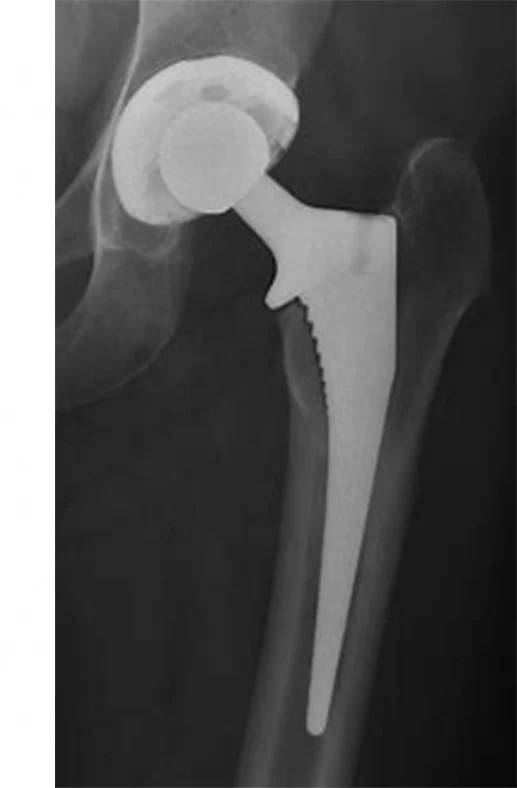
Titanium’s oxide layer does more than prevent corrosion — it’s biologically inert. TiO₂ doesn’t trigger immune responses, doesn’t leach ions into surrounding tissue, and doesn’t degrade in the chloride-rich environment of the human body.
This is why titanium dominates orthopedic and dental implant markets. An implant that corroded would release metal ions, trigger inflammation, and potentially fail. TiO₂’s stability in physiological fluids (essentially 0.9% NaCl at 37°C) provides the chemical basis for titanium’s decades-long implant survival rates.
Aerospace and High-Temperature Service
Aerospace titanium alloys (Ti-6Al-4V, Ti-6Al-2Sn-4Zr-2Mo) maintain corrosion resistance at elevated temperatures — useful for engine components and airframe structures that experience thermal cycling. However, titanium’s oxidation resistance degrades significantly above approximately 400°C (752°F), where the oxide layer grows too rapidly and becomes non-protective.
For service temperatures up to 300°C, titanium maintains excellent corrosion resistance in most atmospheric and chemical environments.
Above 400°C, titanium’s oxidation rate accelerates significantly, and the oxide layer becomes non-protective above approximately 600°C for most engineering applications.
When Titanium DOES Corrode: Limitations and Failure Conditions
No material is perfect, and presenting titanium as invincible would undermine the credibility of this article. There are specific environments where titanium’s passive film breaks down and corrosion occurs.
Hydrofluoric Acid (HF)
Hydrofluoric acid is titanium’s most dangerous enemy. HF attacks titanium at extremely low concentrations — even below 1% — by dissolving the TiO₂ layer through formation of soluble titanium fluorides. At higher concentrations and temperatures, dissolution is rapid and potentially violent.
This is critical for chemical plant operators: any process involving HF requires careful material selection, and titanium is definitively off the list.
Hot Reducing Acids
Titanium struggles in hot hydrochloric acid (HCl) and hot sulfuric acid (H₂SO₄) — environments where the oxide layer cannot maintain its passive state:
- HCl: resistant to ~7% at room temperature; poor resistance at higher concentrations or elevated temperatures
- H₂SO₄: resistant to ~5% at room temperature; high corrosion rates at concentrations as low as 0.5% when boiling
The presence of oxidizing agents or multivalent metal ions (Fe³⁺, Cu²⁺) can dramatically improve titanium’s performance in these acids by helping maintain the passive film. Industry practice is to add small amounts of oxidizing inhibitors when titanium must serve in borderline reducing acid environments.
Anhydrous and Dry Chlorine Conditions
In completely dry environments lacking moisture, titanium’s oxide layer cannot form or sustain itself. Dry chlorine gas can attack titanium even at low temperatures — and under sufficiently dry conditions, titanium can ignite and burn.
Water is essential — even trace amounts (50 ppm) are sufficient to maintain passivity in most oxidizing environments. But in truly anhydrous conditions, titanium’s primary protection mechanism fails.
Crevice Corrosion
Under confined geometry conditions — narrow gaps where stagnant fluid can develop acidic, oxygen-depleted chemistry — titanium can experience localized crevice corrosion. This typically occurs in NaCl solutions at temperatures down to 70°C under heat transfer conditions.
Crevice corrosion is the most practically significant corrosion mechanism for titanium in seawater service. Design mitigation includes:
- Minimizing crevice geometry
- Using crevice-resistant alloys (Grade 7, Grade 12)
- Applying cathodic protection
- Selecting compatible gasket and fastener materials
Stress Corrosion Cracking (SCC)
Titanium alloys — especially aluminum-containing grades — can experience SCC under specific conditions:
- Methanol: Intergranular cracking possible at moisture content below 1.5% for unalloyed titanium; CP grades need at least 2% water for immunity, with higher-alloyed grades requiring 3–10%
- Red fuming nitric acid: SCC risk under anhydrous conditions; 1.5–2% water completely inhibits cracking
- Hot salt: Demonstrated in laboratory settings (typically 260–480°C range) but no service failures have been reported
Titanium Grades and Corrosion Resistance: Not All Titanium Is Equal
The commercially pure titanium grades most commonly used for corrosion service are:
| Grade | Composition | Key Corrosion Feature |
|---|---|---|
| Grade 1 | CP Ti (0.18% O₂ max) | Most ductile, good general corrosion resistance |
| Grade 2 | CP Ti (0.25% O₂) | Workhorse grade — best balance of strength and corrosion resistance |
| Grade 4 | CP Ti (0.40% O₂) | Highest strength CP grade, excellent corrosion resistance |
| Grade 7 | Ti + 0.12–0.25% Pd | |
| Grade 12 | Ti + 0.8% Ni + 0.3% Mo | Improved crevice corrosion resistance, lower cost than Grade 7 |
Grade 2 is the default choice for most corrosion-resistant applications. Grade 7 and Grade 12 are specified when reducing acid environments or elevated crevice corrosion temperatures are concerns.
High-strength alloys (Ti-6Al-4V, Ti-5Al-5V-5Mo-3Cr) generally exhibit inferior corrosion resistance compared to commercially pure grades. The aluminum, tin, and vanadium additions that provide strength can increase pitting susceptibility.
Does Titanium Tarnish, Discolor, or Change Color?
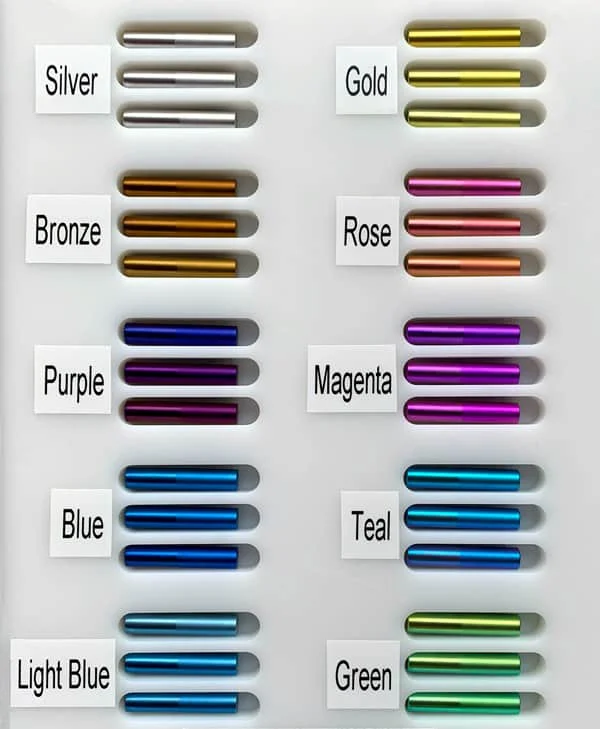
Titanium does not tarnish in the way silver or copper does — it doesn’t develop a dark patina or green corrosion product.
However, titanium can develop surface discoloration through two mechanisms:
- Heat tinting: When titanium is heated in air (during welding, for example), the oxide layer thickens. Different thicknesses interfere with visible light to produce a spectrum of colors — from light gold (~5–8 nm) to deep purple (~38–45 nm) to blue (~30–35 nm) to grey (~50+ nm). This is the same phenomenon that creates anodized titanium jewelry colors. The discoloration is purely the oxide layer and does not compromise corrosion resistance.
- Contact staining: Titanium can develop surface marks from contact with other metals, particularly copper, brass, or stainless steel, in the presence of an electrolyte (even fingerprint moisture). This is superficial and can be removed by gentle cleaning with a non-abrasive product.
In everyday use — watches, rings, cookware, bicycle frames — titanium maintains its natural silver-grey appearance for decades without polishing or special maintenance.
Practical Applications: Where Titanium’s Corrosion Resistance Matters Most
Marine Hardware and Shipbuilding
Titanium is used for seawater piping, heat exchangers, condenser tubes, offshore platform components, and desalination equipment. The economic case: while titanium costs 5–10x more than 316 stainless steel, its maintenance-free service life in seawater typically exceeds 40 years, versus 10–20 years for stainless steel alternatives.
Medical Implants
Titanium’s biocompatibility is directly linked to its passive TiO₂ layer. Hip replacements, dental implants, bone plates, and spinal fusion devices rely on titanium’s corrosion resistance to maintain structural integrity for 20+ years inside the human body.
Chemical Processing
Process vessels, heat exchangers, piping, and valve components in nitric acid, acetic acid, and chloride-containing services. Grade 7 titanium extends this to sulfuric and hydrochloric acid applications.
Consumer Products
Titanium watches (Corrosion-resistant enough to handle saltwater, sweat, and daily wear indefinitely), bicycle frames (especially valued by touring cyclists who ride in all weather), cookware (lightweight, non-reactive with acidic foods), and jewelry (hypoallergenic — TiO₂ doesn’t cause skin reactions).
Aerospace
Airframe structures, engine compressor blades, and hydraulic tubing in aircraft. The corrosion resistance matters because aircraft experience rapid temperature cycling between cold, humid conditions at altitude and warm, salt-laden coastal environments on the ground.
FAQ
Does titanium rust in water?
No. Pure titanium does not rust in water of any kind — fresh water, salt water, chlorinated water, or mineral water. The TiO₂ oxide layer forms immediately upon contact with water and provides complete protection. Titanium is rated for continuous seawater service up to 260°C (500°F) for general corrosion.
Does titanium corrode in salt water?
Titanium is essentially immune to corrosion in seawater. It shows negligible erosion at flow rates up to 18 m/s (~35 knots) and has documented service life exceeding 40 years in marine piping systems. Chloride ions that attack stainless steel actually help maintain titanium’s passive film.
Can titanium rust if scratched?
No. If titanium is scratched, the exposed metal reforms its TiO₂ oxide layer automatically — the initial electrochemical repassivation occurs within milliseconds, restoring full corrosion protection. This self-healing ability means scratches do not compromise long-term corrosion resistance — a significant advantage over painted or coated metals.
Does titanium jewelry rust?
No. Titanium jewelry does not rust, tarnish, or corrode in normal wear conditions — including exposure to sweat, saltwater, and chlorine. It is one of the most maintenance-free jewelry metals available. The only way titanium jewelry can develop surface marks is through contact staining from other metals.
What chemicals can corrode titanium?
The primary chemicals that attack titanium are: hydrofluoric acid (HF) — even at 1% concentration; hot concentrated hydrochloric acid; hot concentrated sulfuric acid; dry chlorine gas; red fuming nitric acid (anhydrous); and methanol (at low moisture content). Most of these conditions are uncommon outside industrial chemical processing.
Is titanium better than stainless steel for corrosion resistance?
For chloride-rich environments (seawater, salt spray, swimming pools), titanium is significantly better — it is immune to chloride-induced pitting that eventually affects stainless steel. For general atmospheric exposure, both materials perform well. The choice often depends on cost: titanium costs 5–10x more upfront but can provide 2–4x longer service life in aggressive environments.
Does titanium rust with sweat?
No. Titanium does not corrode from human sweat. Sweat contains salts (primarily sodium chloride at ~0.1–0.5%), but titanium’s passive film is completely unaffected by this concentration. This is one reason titanium is popular for body jewelry, watches, and athletic equipment.
How thick is the titanium oxide layer?
The natural TiO₂ oxide layer on titanium starts at approximately 3–6 nanometers when exposed to ambient air, and grows to roughly 25 nanometers after several years in ambient air. For decorative coloring, anodized titanium oxide layers typically range from 15–180 nm.
Summary: Why Titanium’s Corrosion Resistance Is Engineering-Grade, Not Just Marketing
Titanium does not rust because it contains no iron, and it resists nearly all forms of corrosion through a self-healing TiO₂ oxide layer that forms within seconds of surface exposure. This 3–25 nm film is thermodynamically stable, requires no maintenance or chemical treatment, and performs in environments — particularly chloride-rich seawater — where stainless steel eventually fails.
The data is clear: titanium shows negligible corrosion in seawater up to 260°C for general corrosion (with crevice corrosion limits starting at 82°C), withstands nitric acid at most concentrations, and maintains its passive film with as little as 50 ppm of ambient moisture. Its self-healing response after mechanical damage begins within milliseconds — faster than any competing engineering metal.
The tradeoff is cost and machinability: titanium costs 5–10x more than stainless steel and requires specialized fabrication techniques. But for applications where corrosion failure means safety risk, environmental contamination, or costly downtime — marine systems, chemical processing, medical implants — titanium’s corrosion resistance delivers measurable economic value over its service life.
Understanding both the capabilities and the limitations (hydrofluoric acid, hot reducing acids, crevice corrosion under specific conditions) is essential for proper material selection. Titanium is not invincible — but within its operational envelope, it is as close to a corrosion-proof metal as materials science has produced.