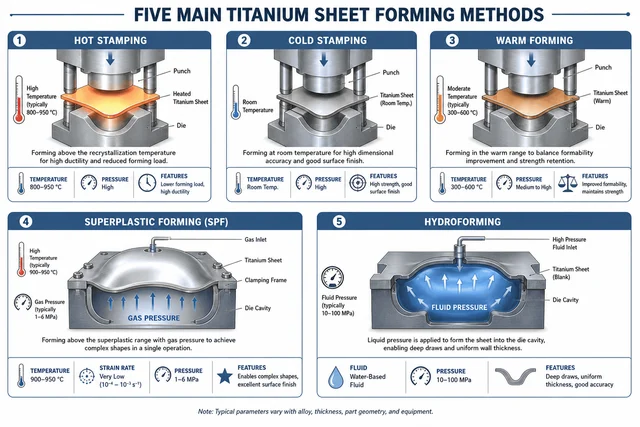
Titanium stamping and forming requires fundamentally different approaches than steel or aluminum due to titanium’s high strength-to-weight ratio, low ductility at room temperature, severe springback (modulus ~114 GPa vs steel’s ~200 GPa), and tendency to gall. Five main methods exist: hot stamping (704–760°C for Ti-6Al-4V), cold stamping (limited to CP grades with generous radii), warm forming (~270°C), superplastic forming (~850–927°C), and hydroforming. Springback compensation, die material selection (carbide vs. tool steel), and proper lubrication are the three factors that determine success on the production floor. This guide covers process parameters, tooling strategies, and real-world considerations for each method, based on both published data and production experience.
What Is Titanium Stamping and Forming Technology?
Titanium stamping and forming refers to the set of processes that transform titanium sheet, plate, or strip into shaped components using dies and presses. Unlike carbon steel or aluminum, titanium presents unique challenges: high yield strength (up to 880 MPa for Ti-6Al-4V), limited room-temperature elongation (10–24% depending on grade), and a strong tendency to work-harden during deformation.
The key distinction that any engineer planning a titanium stamping project needs to understand is grade dependency. CP (commercially pure) titanium Grades 1 through 4 can be cold-formed with careful tooling design, while alpha-beta alloys like Ti-6Al-4V almost always require elevated temperatures for any significant deformation. I have personally worked on projects where specifying the wrong forming temperature for a Grade 5 part led to cracking in the first 50 pieces — temperature control is not optional with titanium.
Titanium stamping is governed by the following standards:
- ASTM B265 — Standard specification for titanium and titanium alloy strip, sheet, and plate
- AMS 4911 — Titanium alloy sheet, strip, and plate (Ti-6Al-4V, annealed)
- AMS 4928 — Titanium alloy bars, wire, forgings, and rings (Ti-6Al-4V, annealed)
- ISO 5832-2 / ISO 5832-3 — Implant-grade titanium (CP and Ti-6Al-4V)
These standards define the mechanical property minimums, chemical composition limits, and testing requirements that any stamped titanium component must meet.
Titanium Alloys Used in Stamping — Which Grades Work Best?
Not all titanium alloys stamp equally. The alloy choice directly determines which forming process is feasible, what tooling is required, and what the per-part cost will be.
CP Titanium (Grades 1–4)
CP titanium grades have no alloying elements — they are essentially pure titanium with varying levels of interstitial oxygen and iron. Higher grade numbers mean higher strength but lower formability.
| Grade | UNS | UTS (MPa) | YS (MPa) | Elongation | Formability Rating |
|---|---|---|---|---|---|
| Grade 1 | R50250 | 240 | 170 | 24% | Excellent |
| Grade 2 | R50400 | 345 | 275 | 20% | Very Good |
| Grade 3 | R50550 | 450 | 380 | 18% | Good |
| Grade 4 | R50700 | 550 | 483 | 15% | Fair |
CP Grade 1 and 2 are the most common choices for cold stamping and deep drawing. In my experience, Grade 1 will accept a bend radius of about 1.5x material thickness at room temperature, while Grade 4 needs at least 3x — and even then, you will see microcracking on the tension side if the edge quality is poor.
Ti-6Al-4V (Grade 5)
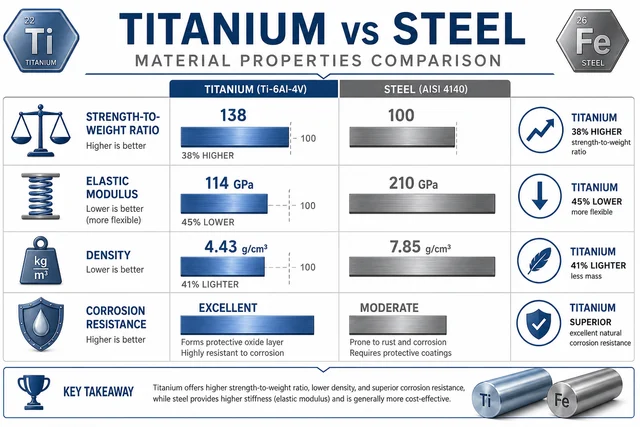
Ti-6Al-4V is the most widely used titanium alloy, accounting for roughly 50% of all titanium tonnage. Its mechanical properties are impressive: UTS 950 MPa (138 ksi) in the annealed condition, YS 880 MPa (128 ksi), with elongation of 10–14% per AMS 4911. Density is 4.43 g/cm³ — roughly 56% of steel.
The alloy’s alpha-beta microstructure provides excellent strength but limited formability at room temperature. At room temperature, the minimum bend radius for Ti-6Al-4V sheet is approximately 4.5x material thickness. At 800°C, that drops to about 1x thickness as yield strength falls by a factor of roughly 100.
Ti-5Al-2.5Sn (Grade 6)
This alpha alloy offers UTS of 861 MPa (125 ksi), YS of 827 MPa (120 ksi), and 15% elongation. Its key advantage is creep resistance up to 480°C, making it suitable for high-temperature aerospace applications. However, it cannot be heat-treated and is more expensive than Grade 5. It is typically hot-formed only.
Other Alloys
Ti-3Al-2.5V (Grade 9) is used in hydraulic tubing and sports equipment, offering a middle ground in formability. Beta alloys like Ti-15V-3Cr-3Al-3Sn (Ti-15-3) offer excellent cold formability because of their body-centered cubic structure — they can be stamped cold and then aged to high strength. I have used Ti-15-3 for complex geometries where aero-grade performance was required but Grade 5 would not form without hot dies.
The 5 Key Titanium Forming Methods Compared
1. Hot Forming / Hot Stamping
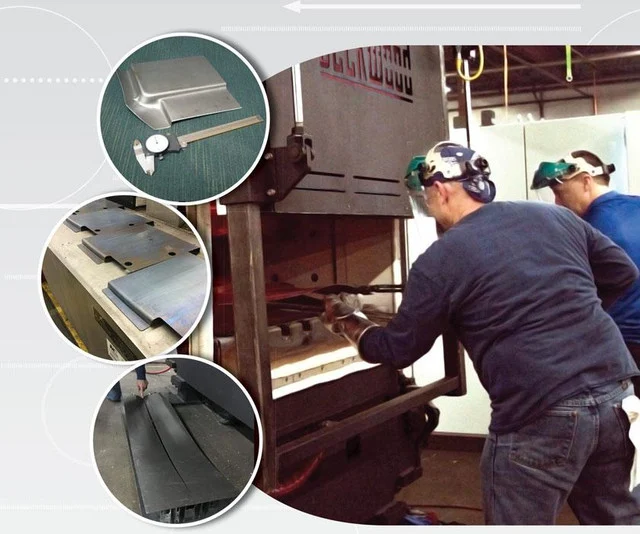
Hot forming is the standard approach for Ti-6Al-4V and other alpha-beta alloys that cannot be formed cold.
In hot forming, the titanium blank is heated to a specific temperature range and then formed in a heated or unheated die. The temperature range varies by alloy severity:
| Forming Severity | Temperature Range |
|---|---|
| Mild forming | 200–315°C (400–600°F) |
| Moderate to severe | 480–540°C (900–1,000°F) |
| Difficult alloys | 650–815°C (1,200–1,500°F) |
| Hot stamping (Ti-6Al-4V) | 825–875°C (1,517–1,607°F) |
| Superplastic forming | ~850–927°C (1,560–1,700°F) |
For Ti-6Al-4V specifically, the widely used hot forming window is 704–760°C (1,300–1,400°F). Below this range, the material retains too much strength to form without cracking. Above it, excessive oxidation and grain growth become problems.
Hot stamping of Ti-6Al-4V has been demonstrated at 825–875°C in controlled atmosphere conditions (per MDPI Materials research), showing that the alloy can be formed successfully with proper temperature management and rapid transfer times.
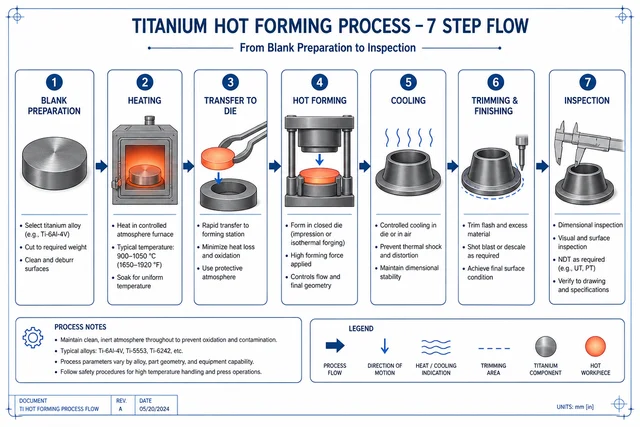
The hot forming workflow typically follows this sequence:
- Blank preparation — laser or waterjet cut, deburred
- Pre-heat blank in furnace — typically at forming temperature for 10–30 minutes
- Transfer to press — critical step, as the blank cools rapidly
- Forming cycle — controlled speed and pressure
- Stress relief / hot sizing — 1,100°F+ for several minutes to stabilize shape
- Cool-down — controlled rate to avoid distortion
- Inspection — dimensional and surface quality check
2. Cold Stamping
Cold stamping of titanium is economically attractive — no heating equipment, faster cycle times, and lower energy costs. The trade-off is that it only works for select alloys and geometries.
CP Titanium Grades 1 and 2 are the primary candidates for cold stamping. Even then, certain design rules must be followed:
- Bend radii: minimum 1.5–2x material thickness for Grade 1, 2–3x for Grade 2
- Avoid sharp corners — use generous fillets
- Limit draw depth — shallow draws only
- Allow for 15–20% springback in tool design
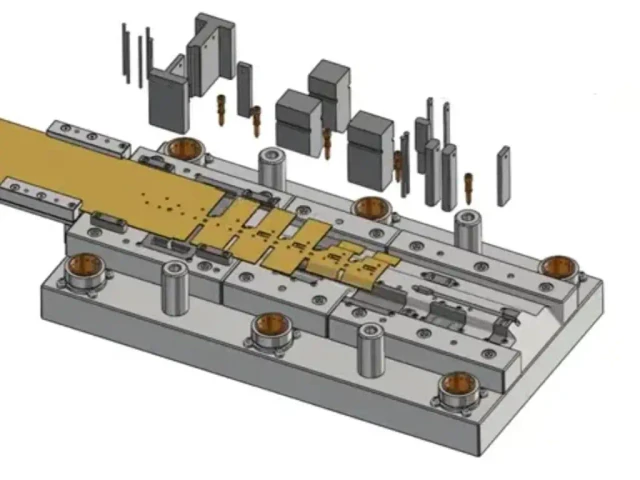
- Use progressive dies with multiple hits rather than single-strike forming
A common mistake I have seen is applying steel or aluminum stamping design rules to titanium. Titanium’s lower elastic modulus (114 GPa vs. 200 GPa for steel) means it springs back nearly twice as much. A tool designed for steel will produce undersized titanium parts.
3. Warm Forming / High-Pressure Warm Forming (HPWF)
Warm forming fills the gap between cold and hot forming. The benchmark HPWF process operates at ~270°C (520°F) with fluid pressure up to 20,000 PSI (per The Fabricator’s reporting). At this temperature, the yield strength of CP titanium drops significantly while oxidation remains negligible.
HPWF uses a rubber diaphragm and hydraulic fluid to apply uniform pressure, forming the sheet against a single tool surface. This is particularly useful for:
- Complex geometries with deep draws
- Parts requiring tight tolerances
- Prototype or medium-volume production where hard dies are not justified
The advantage of warm forming over hot forming is speed: no furnace pre-heat, lower die temperatures, and shorter cycle times. The trade-off is that it does not work for high-strength alloys like Ti-6Al-4V in thick gauges.
4. Superplastic Forming (SPF)
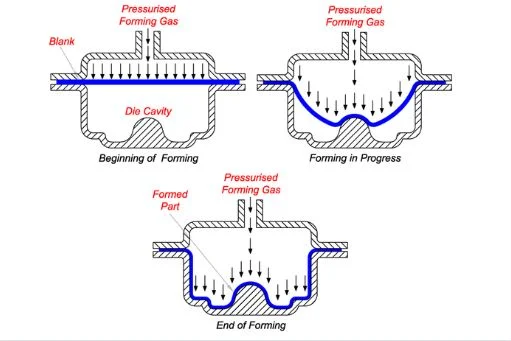
Superplastic forming exploits the fact that certain titanium alloys exhibit extreme elongation (200–1,000%) at specific temperatures and strain rates. Ti-6Al-4V is the most common SPF alloy, formed at ~850–927°C (1,560–1,700°F).
In SPF, gas pressure (typically argon) forces the heated sheet into a single-sided die. The slow, controlled deformation rate allows the material to “flow” into complex shapes without tearing. The process can produce geometries that would be impossible with conventional stamping — deep cavities, sharp details, and variable thickness distributions.
The main limitation of SPF is cycle time. A typical SPF cycle can take 20–60 minutes per part, compared to seconds for hot stamping. This limits SPF to:
- Aerospace components (where part count is low and complexity is high)
- Parts that consolidate multiple stamped pieces into one
- Low-volume, high-value production
I have seen SPF used effectively for titanium engine nacelle components where a single SPF part replaced 7-piece weldments, saving 40% in assembly cost despite the longer per-part cycle.
5. Hydroforming
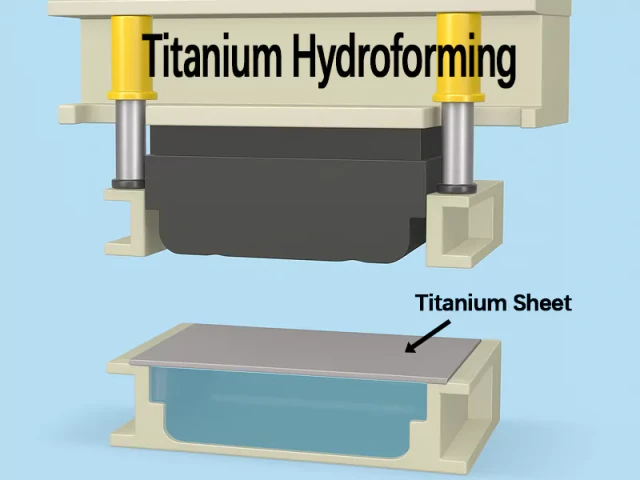
Hydroforming uses high-pressure hydraulic fluid (water or oil) to form titanium sheet against a single die. The key difference from HPWF is that hydroforming operates at higher pressures and typically at room temperature or moderate temperatures.
For CP titanium, hydroforming at room temperature can produce medium-complexity parts with good surface finish, provided generous radii are used. For Ti-6Al-4V, warm hydroforming (at 200–300°C) is usually required.
Hydroforming offers several advantages for titanium:
- No die matching required — single tool surface
- Good surface finish on the die side
- Reduced springback compared to mechanical stamping
- Suitable for small to medium production runs
The downsides include slower cycle times compared to progressive die stamping and the need for a high-pressure fluid system.
Process Parameters at a Glance — Reference Table
This table consolidates the temperature, pressure, cycle time, and applicability for each forming method based on published data and industry practice.
| Method | Temperature Range | Typical Pressure | Cycle Time | Alloy Suitability | Relative Tooling Cost | Relative Part Cost |
|---|---|---|---|---|---|---|
| Cold Stamping | Room temp | Standard press (50–500 tons) | 2–10 seconds | CP Grade 1, 2 only | $$ (steel dies) | $ |
| Warm Forming (HPWF) | 200–315°C | 20,000 PSI max | 15–60 seconds | CP Grades, Grade 9 | $$$ (heated die + fluid) | $$ |
| Hot Forming | 480–815°C | Standard press | 10–60 seconds | All commercial grades | $$$ (heated die) | $$ |
| Hot Stamping (Ti-64) | 825–875°C | Standard press | 5–30 seconds | Ti-6Al-4V, others | $$$$ (high-temp tooling) | $$$ |
| Superplastic Forming | 850–927°C | 200–400 PSI gas | 20–60 minutes | Ti-6Al-4V, Ti-6Al-2Sn-4Zr-2Mo | $$$$ (one-sided die) | $$$$ |
| Hydroforming | RT – 300°C | Up to 10,000 PSI | 30–120 seconds | CP grades (RT), Ti-64 (warm) | $$$ (single die + fluid) | $$ |
Note: The cost estimates above are relative within this table and vary significantly with part geometry, volume, and tolerance requirements.
The Springback Challenge — Why Titanium Springs Back More Than Steel
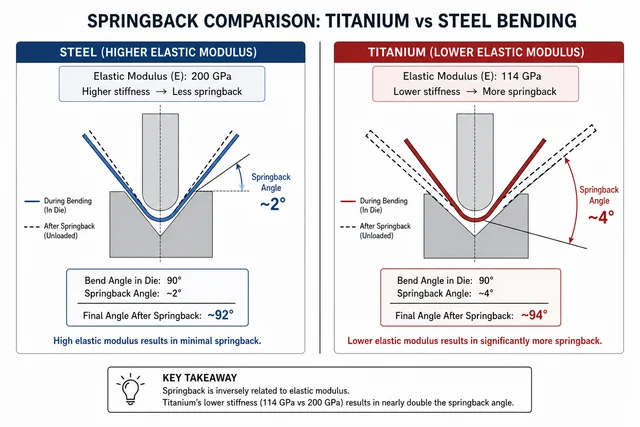
Springback is the single most frustrating problem in titanium stamping. Here is the engineering reality: titanium’s elastic modulus is roughly 114 GPa — about half of steel’s 200 GPa. Since springback is proportional to the ratio of yield strength to elastic modulus, titanium’s high YS and low E combine for severe elastic recovery.
For Ti-6Al-4V, the yield strength of 880 MPa divided by the modulus of 114 GPa gives a springback factor roughly 3x that of mild steel. In practical terms: if a steel part springs back 2 degrees from a 90-degree bend, the same geometry in Ti-6Al-4V will spring back 6 degrees or more.
How We Compensate for Springback
Over years of producing titanium stampings, the industry has developed several reliable compensation methods:
1. Overbending / Die Compensation (CAD-based)
The most straightforward approach: modify the die geometry so the part springs back to the desired shape. Finite element simulations (typically using LS-DYNA or AutoForm) compute the required compensation. The compensated tool surface is then imported directly into CAM for machining.
The “Displacement Adjustment” (DA) method takes the springback simulation results and translates mesh nodes in the opposite direction of the predicted springback by the same magnitude. After one or two iterations, this typically achieves tolerance.
2. Hot Sizing
After cold forming, the part is held in a heated sizing die at 1,100°F+ (593°C+) for several minutes. This allows stress relaxation and sets the part geometry to the tool surface. Hot sizing is used extensively in aerospace titanium forming and is specified in many AMS forming practices.
3. Warm Forming to Reduce Springback
Forming at elevated temperatures reduces the material’s yield strength during deformation, which directly reduces the elastic recovery. This is one reason warm forming and hot forming produce more dimensionally consistent parts than cold stamping.
4. Variable Blank Holder Force (VBHF)
Dynamically adjusting the blank holder force during the press stroke changes the stress distribution in the formed part. Higher BHF in certain zones can reduce springback by stretching the material beyond its elastic limit more uniformly.
5. Multi-Stage Forming
Rather than forming in a single hit, progressive dies with multiple forming stations gradually shape the titanium, allowing stress relaxation between hits. This is standard practice in high-volume CP titanium stamping.
The first time I specified titanium stampings for an aerospace bracket, I designed the tooling with steel springback factors. The first parts came out of the press and the flange angle was off by nearly 8 degrees. After that, I never touched a titanium tooling design without running FEA first.
Die Materials and Tooling for Titanium Stamping
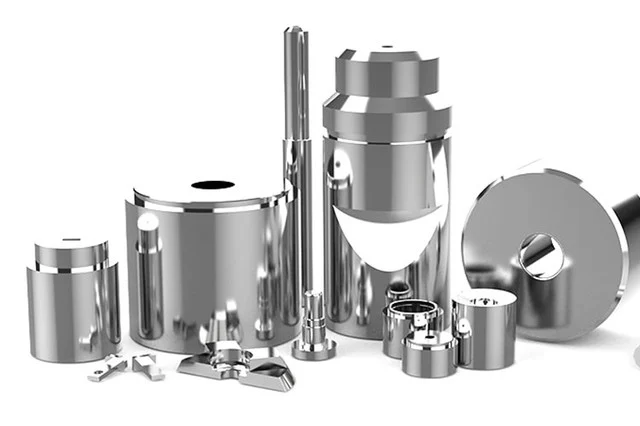
Titanium is abrasive. Its high hardness, work-hardening behavior, and tendency to gall make tooling material selection critical.
Die Material Options
| Material | Hardness | Wear Resistance | Cost Index | Best For |
|---|---|---|---|---|
| Tungsten carbide (WC-Co) | 88–92 HRA | Excellent (10–30x tool steel) | 5x | High-volume, tight tolerance |
| D2 tool steel | 58–62 HRC | Good | 1x (baseline) | Medium-volume prototype |
| A2 tool steel | 57–62 HRC | Good | 0.9x | General purpose, less abrasive |
| H13 (hot work) | 48–55 HRC | Fair at high temp | 1.2x | Hot forming dies |
| High-speed steel (M2) | 60–65 HRC | Very good | 2x | Shear edges, trim tools |
| Stellite (Co-Cr alloy) | 48–58 HRC | Excellent (hot) | 4x | Hot forming, high temp |
Our experience with tool material selection:
For cold stamping CP titanium at volumes under 50,000 parts per year, D2 tool steel performs adequately with proper maintenance. Beyond that threshold, tungsten carbide inserts at the wear points pay for themselves in reduced downtime.
For hot forming above 600°C, standard tool steels soften and wear rapidly. H13 hot work steel is the baseline here, with hard-face overlay (Stellite or Tribaloy) applied to the most heavily loaded surfaces. I have seen H13 dies produce over 10,000 Ti-6Al-4V hot-formed parts before needing refurbishment, while uncoated D2 dies failed in under 500 parts at the same temperature.
Surface treatments that extend die life for titanium stamping:
- PVD TiAlN coating — reduces galling, extends tool life 2–4x
- Nitriding (gas or plasma) — increases surface hardness, good for CP titanium
- DLC (diamond-like carbon) — excellent anti-galling for cold stamping
- Chromium plating — economical option for moderate improvement
Lubrication Strategies for Titanium Sheet Forming
Lubrication in titanium stamping serves a different purpose than in steel stamping. Titanium’s tendency to gall — where microscopic welds form between the workpiece and tool surface — makes effective lubrication essential. A galled tool surface will produce scratched parts within a few strokes and can render a die unusable.
Lubricant Types for Titanium Forming
1. Solid Film Lubricants
- Molybdenum disulfide (MoS₂): The industry standard for both cold and hot forming. Applied as a dry film coating or suspended in a carrier. Effective up to 350°C in air, higher in inert atmospheres.
- Graphite: Good for hot forming applications up to 500°C. Less effective than MoS₂ for cold forming but more thermally stable.
- Boron nitride (BN): Superior high-temperature performance — effective beyond 1,000°C. Used in SPF and high-temperature hot forming.
2. Glass Lubricants
Glass coatings are applied to titanium blanks for hot forming and extrusion. At forming temperatures (700–950°C), the glass softens and provides a continuous lubricating layer between the workpiece and die. These are the standard lubricant for titanium hot forming in aerospace applications.
3. Polymer-Based Coatings
Water-based acrylic and PVA coatings are common in CP titanium stamping. They are applied to the blank before forming and provide both lubrication and a protective barrier. They burn off cleanly during any subsequent heat treatment.
4. Oil-Based Lubricants
Chlorinated and sulfurized EP (extreme pressure) oils work for moderate cold stamping of CP titanium. They are not suitable for high-temperature use and require thorough cleaning after forming.
A practical note from the shop floor: For hot stamping Ti-6Al-4V, we typically use one of two approaches — spray a graphite-MoS₂ suspension onto the preheated blank immediately before forming, or apply a glass coating to the blank before furnace heating. The glass coating produces better results for deep draws but is harder to remove after forming. For CP titanium cold stamping, a water-based polymer coating applied by roller is the most production-friendly solution we have found.
Real-World Applications by Industry
Aerospace
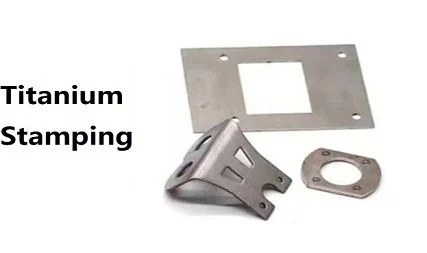
Aerospace is the largest consumer of titanium stampings. The sector uses titanium for its strength-to-weight ratio, corrosion resistance, and fatigue performance.
Typical stamped titanium components include:
- Firewall shields and thermal protection panels (CP Grade 2, hot formed)
- Engine bracket assemblies (Ti-6Al-4V, hot formed or SPF)
- Ducting and environmental control system components (CP Grade 2, warm formed)
- Floor structure supports and seat tracks (Ti-6Al-4V, hot formed)
- Leading edge and nacelle components (SPF)
Aircraft manufacturers specify AMS standards for all titanium forming processes, and every batch of stamped parts must be accompanied by certifying documentation showing material traceability, process parameters, and inspection results.
Medical Devices
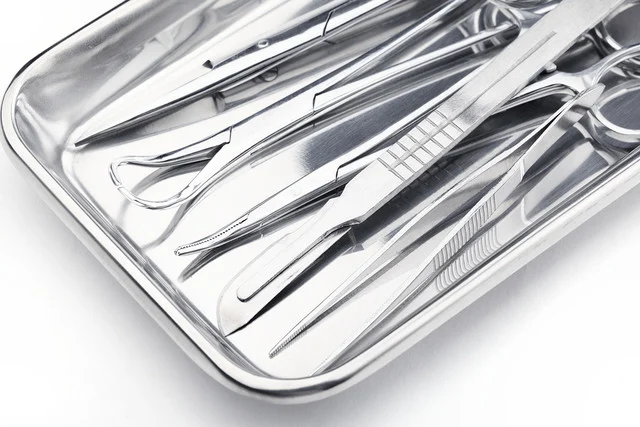
Medical-grade titanium (CP Grade 2 per ISO 5832-2 and Ti-6Al-4V ELI per ISO 5832-11) is used for implantable devices and surgical instruments.
Typical stamped medical components:
- Surgical instrument handles and grips (stamped and formed to ergonomic shapes)
- Bone plate blanks (stamped, then machined to final dimensions)
- Orthopedic implant components (small, precise stampings)
- Dental implant components
Medical stamping requires clean-room compatible processes and documentation of every process step. Surface finish is critical — no scratches, no contamination, no burrs.
Automotive
Automotive use of titanium stampings is limited by cost, but growing in high-performance and luxury segments:
- Exhaust system heat shields (CP Grade 2, warm formed)
- Connecting rods in high-performance engines (forged, not stamped)
- Spring retainers and valve springs (small stampings)
- Suspension components in supercars and racing
The automotive industry’s high-volume requirements usually push designers toward alternative materials, but titanium stampings find a home in vehicles where weight reduction at any cost is justified.
Chemical Processing
Titanium’s corrosion resistance makes it ideal for chemical processing equipment:
- Valve and pump components
- Heat exchanger baffles and spacers (stamped from CP Grade 2)
- Reaction vessel liners
- Piping system components
In chemical processing, the stamping process itself must not create surface defects that could serve as corrosion initiation sites.
Titanium Stamping vs. Alternative Processes
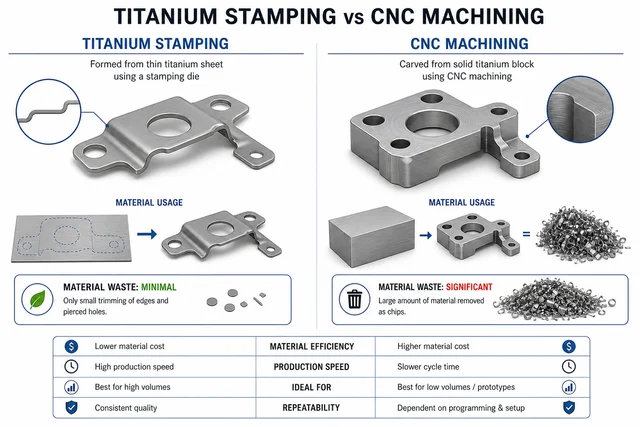
An engineer evaluating a titanium component has several manufacturing options. Here is how stamping compares:
| Factor | Stamping | CNC Machining | Investment Casting | Additive Manufacturing |
|---|---|---|---|---|
| Per-part cost (high volume) | Lowest | High | Medium | Very high |
| Tooling cost | High initial | Low | Medium | None |
| Lead time | 8–16 weeks (tooling) | 1–4 weeks | 6–12 weeks | 1–4 weeks |
| Material utilization | 60–85% | 10–20% | 80–90% | 95%+ |
| Surface finish | Good (3.2 µm) | Excellent (0.8 µm) | Fair (6.3 µm) | Fair (6.3–12.5 µm) |
| Design complexity | Limited by draw ratio | Unlimited | Very high | Highest |
| Suitable volume | >5,000 parts/year | <1,000 parts/year | >500 parts/year | <100 parts/year |
The stamping cost advantage really starts above roughly 5,000 parts per year for simple geometries and 10,000+ for complex ones.
In my experience, the most common mistake engineers make is spec’ing a CNC machined part from titanium plate when a stamping would meet all requirements at a fraction of the cost. A stamped CP Grade 2 bracket that costs $3.50 per piece in volume of 20,000 would cost $18–25 machined from plate — and the mechanical properties of the stamped part, with grain flow following the part contours, are actually superior.
Frequently Asked Questions
How is titanium stamped?
Titanium is stamped using either cold or hot processes depending on the alloy. CP titanium (Grades 1 and 2) can be cold-stamped with generous bend radii and proper tooling design. Ti-6Al-4V and other high-strength alloys require hot forming at 704–870°C. The process follows the same general sequence as steel stamping — blanking, forming, trimming — but with tighter temperature control and more aggressive springback compensation.
What temperature is titanium hot formed?
For Ti-6Al-4V, the standard hot forming window is 704–760°C (1,300–1,400°F). Hot stamping at 825–875°C (1,517–1,607°F) has been demonstrated in research. CP titanium can be warm-formed at 200–315°C (400–600°F). Superplastic forming of Ti-6Al-4V operates at ~850–927°C (1,560–1,700°F).
Why is titanium difficult to form?
Three reasons: (1) High yield strength relative to elastic modulus causes severe springback — roughly 3x that of steel. (2) Low room-temperature ductility means the material cracks before fully forming. (3) Titanium work-hardens rapidly and tends to gall against tool surfaces, requiring specialized lubricants and die coatings.
Can titanium be stamped at room temperature?
CP Grades 1 and 2 can be cold-stamped with appropriate design rules — bend radii of 1.5–2x thickness minimum, limited draw depths, and overbent tooling to compensate for 15–20% springback. Ti-6Al-4V and other alpha-beta alloys cannot be cold-formed for any significant geometry; they require elevated temperatures.
What die materials are used for titanium stamping?
D2 and A2 tool steels are the baseline for cold stamping CP titanium at moderate volumes. Tungsten carbide (WC-Co) is preferred for high-volume production, offering 10–30x the wear resistance of tool steel. H13 hot work steel is standard for hot forming dies. Surface treatments such as PVD TiAlN coating and nitriding extend die life significantly.
How much does titanium stamping cost?
Part cost depends on alloy choice, part complexity, volume, and process. Cold-stamped CP Grade 2 parts in volumes above 10,000/year typically range from $1–10 per piece in simple geometries. Hot-formed Ti-6Al-4V parts cost more due to heating requirements and slower cycle times. Tooling costs range from $10,000–100,000+ depending on complexity and whether the die is heated.
What lubricants work for titanium stamping?
MoS₂ (molybdenum disulfide) is the industry standard for both cold and hot forming. Graphite works well above 500°C. Glass lubricants are standard for aerospace hot forming at 700–950°C. Water-based polymer coatings are popular for production CP titanium stamping.
What industries use titanium stamping?
Aerospace is the largest user (engine brackets, firewall panels, ducting). Medical devices (surgical instruments, implant blanks), chemical processing (valves, heat exchanger components), and select automotive applications (exhaust shields, high-performance components) are the other major sectors.
Conclusion — What We Have Learned and Where to Start
Titanium stamping and forming is a well-established manufacturing technology, but it demands a different engineering mindset than forming steel or aluminum. The three factors I watch on every titanium stamping project — temperature control, springback compensation, and tooling material selection — are non-negotiable. Neglect any one of them, and the scrap rate will tell you immediately.
If you are evaluating titanium stamping for a new project, here is my practical advice:
- Start with the alloy. If CP Grade 1 or 2 meets your strength requirements, you can cold stamp it and keep costs low. If you need Ti-6Al-4V properties, budget for hot forming tooling and process development.
- Model springback in FEA. Do not size your tooling based on steel or aluminum experience. The modulus difference guarantees over-springback. Run the simulation, measure the error, and iterate.
- Talk to the lubrication supplier early. Many shop-floor problems — galling, poor surface finish, short die life — trace back to inadequate or wrong lubricant choice. The major lubricant manufacturers offer application engineering support specifically for titanium.
- Volume drives the process decision. Below 5,000 parts per year, hydroforming or warm forming with single-sided tooling may be more economical than hard dies. Above 10,000 parts, progressive hot stamping tooling pays for itself.
- Verify your supply base. Not every stamping shop will run titanium. The material is more expensive per pound, harder on tooling, and requires process controls that steel stampings do not. A shop that produces good steel stampings is not automatically qualified to produce good titanium stampings.
Titanium stamping has a learning curve, but the payoff is real: lighter, stronger, corrosion-resistant components at a fraction of the cost of machining from solid. Get the parameters right and the process is repeatable and reliable.