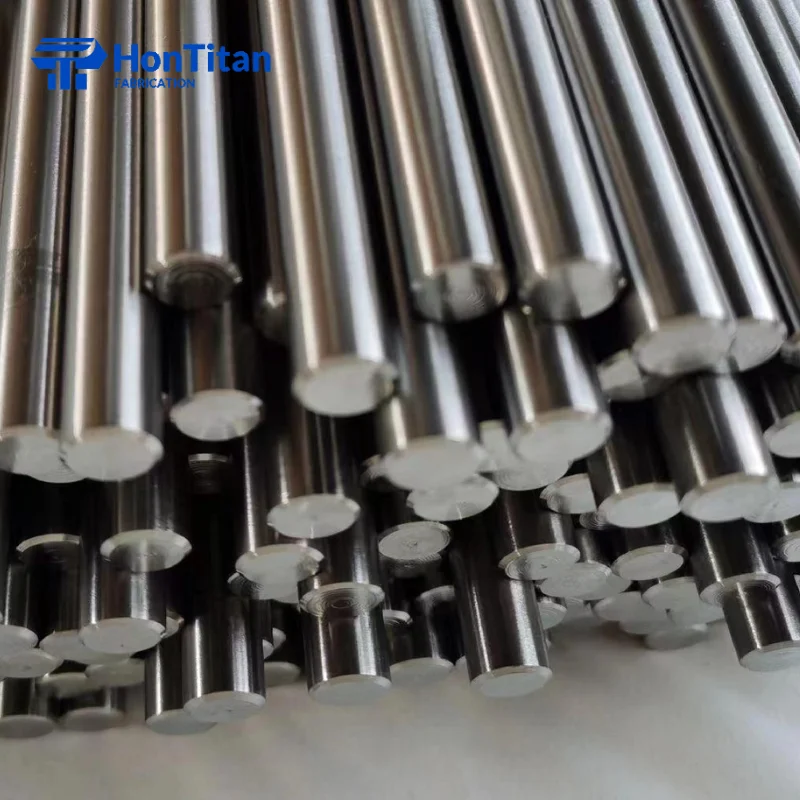
チタンは酸素との反応性が極めて高いため、標準的な砂型鋳造はほとんどの用途に適しておらず、溶融チタンは大気中で発火します。主流の方法は 真空インベストメント鋳造, であり、これはロストワックスセラミックシェルプロセスと密閉真空チャンバーおよび水冷銅スカル溶解炉を組み合わせたものです。真空ダイカストや遠心鋳造など、他の方法も限られたニッチ分野に存在します。本ガイドでは、実用可能なすべてのチタン鋳造方法を詳しく解説し、真空環境の必須要件を説明し、プロセスの経済性を比較するとともに、航空宇宙および医療分野のバイヤーが予算策定時に見落としがちな後処理工程(HIP、アルファケース除去、熱処理)についても説明します。.
チタン鋳造が他の金属と根本的に異なる理由
ほとんどの金属は大気中で砂型に溶かして注ぐことができますが、チタンはそれができません。.
おおよそ1100°C以上の温度では、溶融チタンは酸素および窒素と激しく反応します。溶融物に大気中のガスが溶け込み、脆い酸素富化表面層( アルファケース )が形成されます。また、激しい暴露時には金属が発火する場合があります。これは取り扱い上の不便にとどまらず、鉄鋼、アルミニウム、さらにはニッケル超合金には問題なく適用できる鋳造方法のクラス全体を排除するほどの冶金学的現実です。.
その結果として、 実用可能なチタン鋳造方法のほぼすべてが、真空または制御された不活性雰囲気環境を必要とします。. この単一の制約が、設備、工具、サイクルタイム、サプライヤー資格認定、コストのすべてを根本から変えます。.
これを最初から理解しておくことで、「鋳造を行っている」ものの、チタンに適切な設備を持っていない鋳造所への無駄なRFQサイクルを防ぐことができます。.
4つの主要鋳造方法とチタンへの適合性
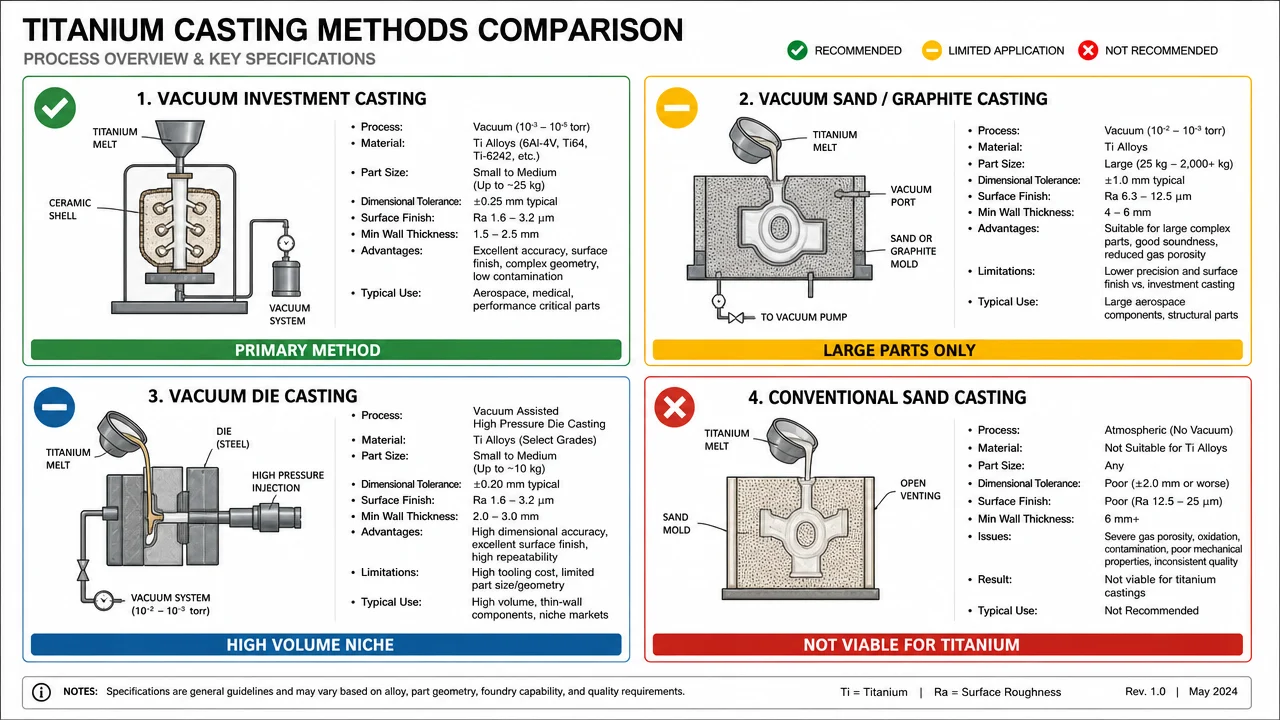
| 方法 | チタンに適合? | 理由 |
|---|---|---|
| 真空インベストメント鋳造 | ✅ 対応 — 主要方法 | 密閉真空チャンバーとセラミックシェルにより大気汚染を防止 |
| 真空ダイカスト | ✅ 対応 — 限られたニッチ | 高圧真空ダイカストは実用可能だが、専用設備が必要 |
| 遠心鋳造 | ✅ はい — 専門的 | リング・チューブに使用;真空環境が必要 |
| 砂型鋳造 | ⚠️ 著しく限定的 | 従来の砂型鋳造は重大なアルファケースを引き起こす;真空砂型鋳造は存在するが,チタンへの使用は稀 |
| 重力金型(永久鋳型) | ❌ 実用不可 | 溶融チタンは鋼または鉄の工具と反応する |
| 標準ダイカスト | ❌ 実用不可 | ショット圧力がチタンの反応性と相容れない;真空制御なし |
このガイドの残りは,実用的に使用されている3つの有効な方法に焦点を当てる:真空インベストメント鋳造,真空ダイカスト,そして — 適用可能な場合 — チタン砂型鋳造。.
真空インベストメント鋳造:チタンの主要プロセス
真空インベストメント鋳造(真空ロストワックス鋳造とも呼ばれる)は,商業用チタン鋳造品の85~90% を担っている。これは,「チタン鋳造」と修飾なしに言う場合,ほとんどの鋳造所が意味する方法である。.
主導的な理由: インベストメント鋳造のニアネットシェイプ能力は,高価で加工が困難な素材の鋳造後の機械加工を最小化する。セラミックシェルはチタンの高い融点(1668°C/3034°F)に耐える。また,このプロセスは本質的にバッチスケーラブルであり,1回の真空炉処理で数十個の部品を同時に鋳造できる。.
真空インベストメント鋳造プロセス:ステップバイステップ
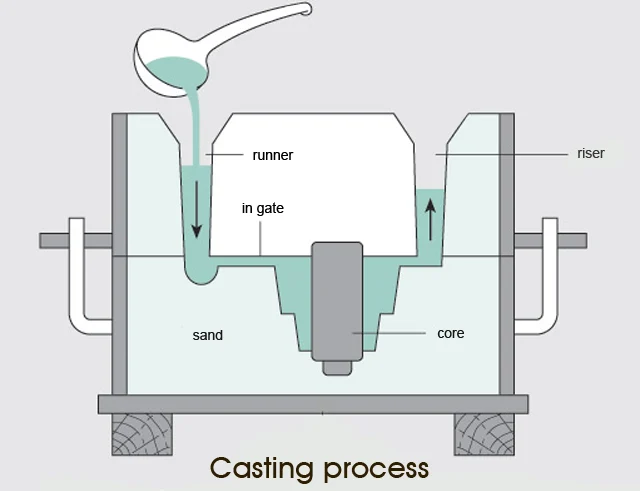
1. パターン製作
目的部品のワックスまたは熱可塑性パターンは,精密に機械加工された工具を使用して射出成形される。高公差 航空宇宙部品では,射出工具からの寸法ばらつきを排除するため,CNCで機械加工されたワックスパターンがますます一般的になっている。.
2. シェル構築
パターンはセラミックスラリーに繰り返し浸漬され、耐火砂でコーティングされます。チタンの場合、標準的なシリカ系シェルでは不十分です — 溶融チタンはシリカ(SiO₂)を還元し、溶湯を汚染します。業界標準では イットリア安定化ジルコニア(YSZ) またはカルシア安定化ジルコニアのフェースコートが使用されており、これらは液体チタンに対して化学的に不活性です。典型的なチタンシェルは8〜12回のディップコートを施し、肉厚8〜12mmに達します。.
3. 脱ろうおよび予熱
シェル鋳型を加熱してワックスパターンを焼き出し、中空のセラミックキャビティを形成します。次に、充填性の向上および熱衝撃の低減を目的として、鋳型を150〜300℃に予熱してから注湯します。.
4. 電極の準備
チタン鋳造所では、通常の装入材料の代わりに 消耗電極 — アーク溶解プロセスにおいて原料かつアノードの両方として機能する、圧縮されたチタン合金棒 — を使用します。電極の組成は目標とする合金仕様(例:Ti-6Al-4Vの鋳造品にはAMS 4991)と一致していなければなりません。.
5. 真空チャンバーの装填および排気
予熱したセラミックシェルとチタン電極を鋳造チャンバーに装填します。チャンバーを密閉し、加熱開始前に大気中の酸素および窒素を除去するため、通常10⁻³ mbar未満の高真空まで排気します。.
6. スカル溶解(VARプロセス)
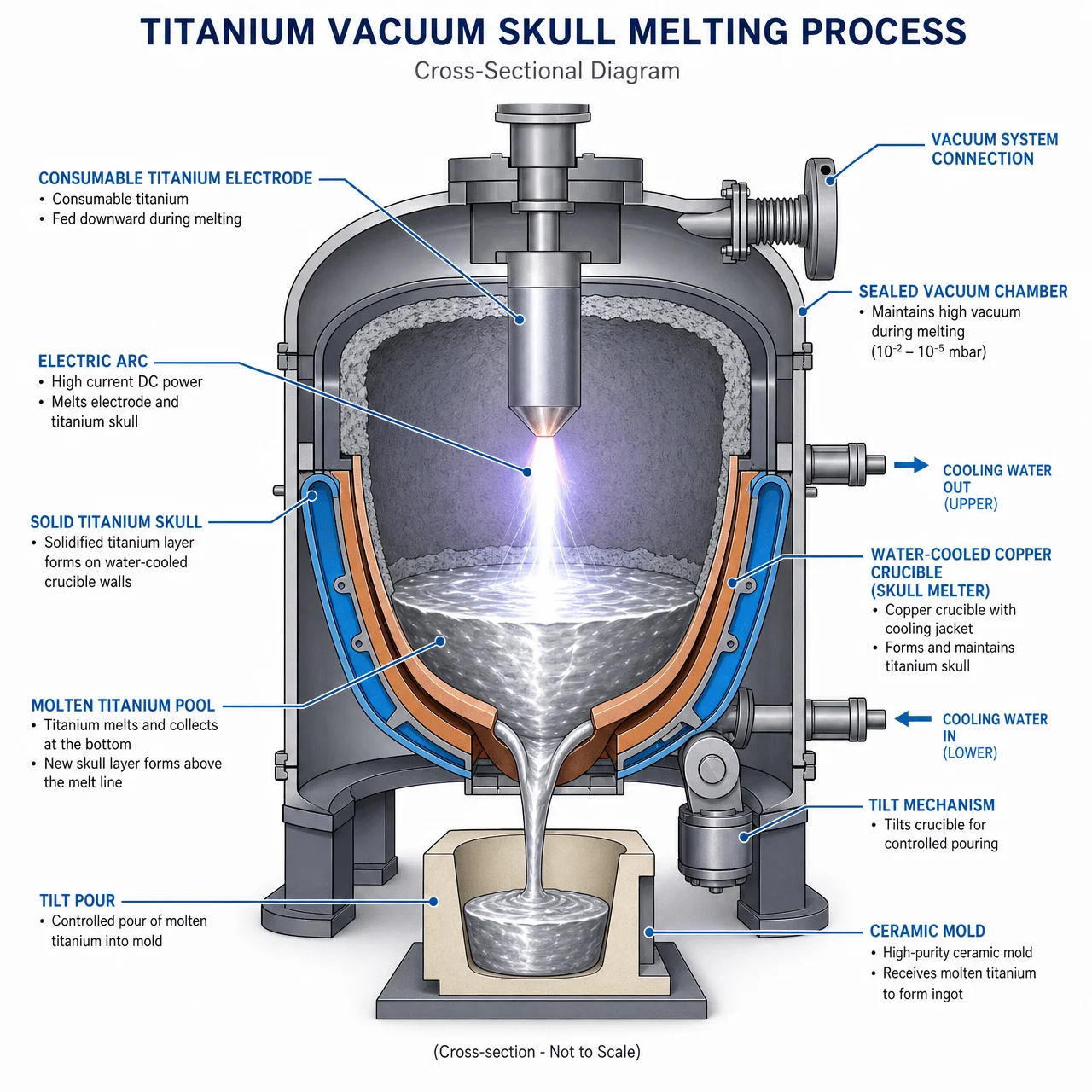
これは、チタンを他の精密鋳造金属と最も大きく区別するステップです。溶融チタンは酸化物セラミックスと反応するため、通常のセラミック坩堝ではなく 水冷銅坩堝(スカルメルター) が使用されます。消耗電極と坩堝内の少量のスターター材料との間に電気アークが発生します。チタンは電極の先端から溶融し、水冷銅ボウル内に溜まります。.
チタンプールの外層は銅壁に接して凝固し「スカル」を形成しますが、内部は液体のまま保たれます。この固体チタンのスカルが、溶融プールと銅との接触を物理的に防ぎます。溶融プール内の温度は1700℃を超えます。.
7. チルトプアーまたは遠心プアー
必要な溶融量に達したら、チャンバーを傾斜させる(または遠心分離機構を作動させる)ことで、溶融チタンを予熱済みシェルに注湯します。注湯の全工程は密閉された真空環境内で行われます。遠心鋳造方式では、薄肉部の充填性を向上させるため、注湯中にシェルを200〜500 RPMで回転させます。.
8. 制御冷却およびシェル除去
鋳造品はチャンバーを開放する前に、真空または不活性雰囲気中で冷却されます。セラミックシェルは、機械的ノックアウト、振動デクラッディング、または高圧水ブラストによって除去されます。.
9. 切断および初期検査
ゲートとライザーが除去されます。その後、初期寸法検査および外観検査が行われます。航空宇宙用途では、初回品検査には通常、三次元測定機(CMM)による寸法確認が含まれます。.
どのような公差が期待できますか?
チタンインベストメント鋳造品が通常達成できる精度:
- 線形寸法 公差: ±0.005 in/in(±0.13 mm/mm) ASTM B372/業界慣行に準拠
- 表面粗さ: Ra 1.6~3.2 µm(63~125 µin)鋳放し — 砂型鋳造より大幅に優れています
- 最小 肉厚: 1.5~2mm ほとんどの合金において
これらの公差は、適切な工具設計およびシェル品質を前提としています。複雑な内部通路、中子、または薄肉部分は、製造性を考慮した設計レビューが必要です。.
チタン砂型鋳造:適した場合と適さない場合
Sand casting is the world’s most common metal casting process — but titanium makes it far more complicated than casting iron or steel.
The fundamental problem: conventional silica sand contains SiO₂ (silicon dioxide). At titanium casting temperatures, molten titanium aggressively reduces SiO₂, pulling oxygen into the melt and depositing silicon contamination. The result is a brittle, oxygen-enriched alpha-case layer on the casting surface that can extend several millimeters deep, requires aggressive chemical milling to remove, and represents a structural liability in load-bearing applications.
This is why the common statement “sand casting can be used for titanium” is technically true but practically misleading for most engineering applications.
Where Titanium Sand Casting Is Actually Used
Titanium sand casting does exist — but it uses non-reactive refractory aggregates, not conventional silica sand. Viable mold materials include:
- Graphite molds (most common for larger titanium parts)
- CaO-stabilized zirconia aggregate
- Calcia (CaO) or yttria (Y₂O₃) face-coat sand molds
And the entire process still requires a vacuum or inert-atmosphere environment for melting and pouring. Open-air titanium sand casting is not viable at production quality.
In practice, titanium “sand casting” (usually graphite mold casting) is used for:
- Large structural aerospace parts (wing carry-through structures, fuselage frames) where the geometry is too large for standard investment casting equipment
- Parts up to 500 kg where investment casting tooling costs are prohibitive
- Low-volume or prototype parts where shell tooling isn’t justified
Trade-offs vs. investment casting:
| パラメータ | 真空インベストメント鋳造 | Vacuum Sand/Graphite Casting |
|---|---|---|
| Surface finish (as-cast) | Ra 1.6–3.2 µm | Ra 6.3–12.5 µm (rougher) |
| Dimensional 公差 | ±0.005 in/in | ±0.010–0.015 in/in |
| Max part size | ~25–50 kg (typical equipment) | 500+ kg feasible |
| 金型費用 | Moderate (wax/ceramic tooling) | Lower (graphite machining) |
| Alpha-case depth | 0.1–0.3 mm (ceramic shell) | 0.3–0.8 mm (graphite mold) |
| 代表的な用途 | Aerospace brackets, medical implants, industrial valves | Airframe structures, large pump casings |
The key takeaway: for any precision or structural titanium casting under ~50 kg, vacuum investment casting delivers better dimensional control and surface finish at comparable cost. Graphite mold casting becomes the practical choice when part size exceeds standard investment casting furnace capacity.
Vacuum Die Casting for Titanium: The High-Pressure Alternative
Vacuum die casting of titanium occupies a narrow but real niche, primarily studied and commercialized in the 1990s–2000s as a route to lower-cost titanium components. Research at ORNL and other institutions demonstrated that vacuum die casting can produce near-net-shape titanium parts with wall thicknesses down to 1mm at cycle times much faster than investment casting.
How it differs from conventional die casting:
- The die cavity is evacuated before injection
- Tooling must be compatible with titanium’s reactivity (specialized die coatings or materials)
- Shot speeds and pressures are modified to prevent turbulence that entraps gas
The catch: titanium’s high 融点 (1668°C) and reactivity with most tool steels makes die longevity a persistent challenge. Standard H13 tool steel dies used for aluminum die casting are not suitable — titanium solders to them and erodes them rapidly. This has limited widespread commercial adoption.
Where vacuum die casting for titanium currently sees use:
- High-volume consumer/automotive Ti components where investment casting tooling amortization is slow
- Thin-wall structural shapes that investment casting struggles to fill consistently
For most aerospace and medical procurement engineers, vacuum investment casting remains the default and the safe choice.
Post-Processing: The Part of Titanium Casting That Surprises Buyers
One of the most common budget surprises in titanium procurement: the casting itself is only part of the cost. Aerospace and medical applications require additional processing steps that add 30–70% to the part cost.
熱間静水圧プレス(HIP)
Titanium investment castings contain micro-porosity from gas entrapment and solidification shrinkage. For structural applications, this porosity must be eliminated. HIP subjects the casting to simultaneous high temperature (~900–950°C) and high isostatic pressure (100–175 MPa / ~15,000–25,000 PSI) in an inert argon atmosphere. This collapses internal voids without changing external dimensions.
HIP is mandatory for flight-critical aerospace castings and for load-bearing medical implants. It is not optional if your part specification calls out AMS 2175 (castings standard) or AMS 2801 (heat treatment). Budget approximately 15–25% cost addition for HIP.
Alpha-Case Removal
Even with a good vacuum, the outermost surface of titanium castings develops a brittle, oxygen-enriched alpha-case layer. For investment castings with yttria-stabilized zirconia shells, this layer is typically 0.05–0.2 mm thick. For graphite mold castings, it can reach 0.5–1.0 mm.
Alpha case must be removed before the part is used in structural applications. Methods:
- Chemical milling (acid etching): Most common; HF/HNO₃ solutions dissolve the surface layer uniformly
- Mechanical removal: Electrochemical machining (ECM) or controlled abrasive blasting in some configurations
NADCAP-certified processing is standard for aerospace applications.
熱処理
Ti-6Al-4V and other alpha-beta alloys typically receive a stress relief anneal or full solution treat + age cycle after casting to achieve target mechanical properties. Required parameters are alloy-specific and specified in AMS 2801 or the customer’s engineering specification.
NDT Requirements
Aerospace castings commonly require:
- X-ray or CT scanning (ASTM E1742 / MIL-STD-453)
- Fluorescent penetrant inspection (FPI per ASTM E1417)
- Chemical analysis (per-heat traceability to AMS or ASTM spec)
These add cost but are non-negotiable for flight hardware. Medical implants add biocompatibility certification requirements (ISO 10993, ASTM F136 for implant-grade Ti-6Al-4V 超低間隙).
Selecting the Right Titanium Casting Method: A Decision Framework
The right casting method depends on four variables: part size, required 公差, production volume, and application criticality.
| 決定要因 | 真空インベストメント鋳造 | Graphite/Sand Mold Casting | 真空ダイカスト |
|---|---|---|---|
| Part weight | <25–50 kg | Up to 500+ kg | <5 kg (typical) |
| 公差 requirement | Tight (±0.005 in/in) | Moderate (±0.010–0.015) | Tight (±0.003–0.005) |
| Surface finish priority | 高い | Low-moderate | 高い |
| ボリューム | Low to medium | 低い | Medium to high |
| Geometric complexity | High — thin walls, internal passages | Low-moderate | Moderate — thin walls |
| Aerospace/medical certifiable | Yes — industry standard | Yes — for large structures | Limited — less established |
| Relative tooling cost | 中程度 | 低い | High (die cost) |
Practical selection rules:
- Part under 25 kg + complex geometry + aerospace/medical = 真空インベストメント鋳造
- Part over 100 kg + simpler geometry + cost-sensitive = vacuum graphite mold casting
- High-volume + thin wall + consumer/automotive = vacuum die casting (if supplier is qualified)
- “Can we sand cast this titanium bracket?” from a conventional foundry = いいえ — redirect to vacuum investment casting
Titanium Casting Grades: Which Alloy to Specify
Three titanium grades represent approximately 95% of castings in production:
CP Titanium グレード2 (Commercially Pure)
- Density: 4.51 g/cm³; 引張強さ: ~345 MPa as-cast
- Standards: ASTM B367, ASME SB367, ASTM F67 (for medical)
- Best for: Maximum 耐食性 applications — chemical process equipment, marine hardware, non-structural medical housings
- Don’t use for: Any load-bearing structural application
Ti-6Al-4V (グレード5 / AMS 4991)
- Density: 4.43 g/cm³; 引張強さ: 895–930 MPa (as-cast, post-HIP)
- Standards: AMS 4991 (casting), ASTM F136 (implant-grade 超低間隙 variant)
- Best for: Aerospace brackets, engine mounts, orthopedic implants, racing components
- Note: “Ti-6Al-4V” and “ASTM F136” are not interchangeable — medical implants require the 超低間隙 (Extra Low Interstitial) variant with tighter oxygen/nitrogen/hydrogen limits
Ti-6Al-2Sn-4Zr-2Mo (Grade 6 / AMS 4999)
- Density: 4.54 g/cm³; significantly higher クリープ resistance than Gr 5
- Standards: AMS 4999
- Best for: Jet engine stators, high-temperature actuators, components with sustained loads above 315°C (600°F)
- Cost: 2–3× Ti-6Al-4V; only justified when operating temperature demands it
Real Cost Ranges for Titanium Castings
Cost transparency is rare in titanium casting. Based on supplier data and industry benchmarks:
| Component Type | 合金 | Rough Cost Range | Key Cost Driver |
|---|---|---|---|
| Simple valve body (50–200g) | CP Gr 2 | $800–$1,500/unit | Small volume, vacuum overhead |
| Aerospace bracket (0.5–2 kg) | Ti-6Al-4V | $1,800–$3,500/unit | HIP + X-ray + cert requirements |
| Medical hip stem (0.3–0.8 kg) | Ti-6Al-4V ELI | $4,000–$7,500/unit | ASTM F136 cert + electropolishing |
| Large structural frame (10–25 kg) | Ti-6Al-4V | $8,000–$25,000/unit | Furnace cycle cost, post-processing |
Raw material cost for Ti-6Al-4V is approximately $80–$120/kg for casting-grade sponge/electrode. But material is typically only 25–40% of total part cost — vacuum processing overhead, specialty ceramics, HIP, NDT, and certification compliance dominate.
The rule of thumb: titanium castings cost 5–10× equivalent stainless steel castings and 15–20× equivalent aluminum castings. This premium is justified when the application demands the strength-to-weight ratio, 耐食性, or biocompatibility that titanium uniquely provides.
Qualifying a Titanium Casting Supplier: What to Ask
Most foundries cannot produce titanium castings. The equipment investment — vacuum arc melting furnaces, copper skull melters, yttria shell systems — runs $2–5M+, and the process expertise takes years to develop. Before sending an RFQ, verify:
Equipment:
- Does the foundry have its own vacuum arc remelting (VAR) or skull melting equipment? (Not outsourced)
- What is the maximum furnace capacity (kg per heat)?
- Is HIP done in-house or at a NADCAP-certified subcontractor?
資格:
- AS9100 Rev D (aerospace quality management) for aerospace parts
- NADCAP accreditation in casting (AC7102) and applicable special processes
- ISO 13485 for medical device applications
- Per-heat material traceability to AMS 4991 or ASTM F136
Process Controls:
- What ceramic shell system do they use? (Answer should reference yttria or calcia face coats — not generic silica)
- What vacuum level is achieved before pour? (Should be sub-10⁻³ mbar)
- What is their documented scrap rate for titanium? (Expect 10–20% for complex parts; significantly higher is a red flag)
Red flags: “We occasionally do titanium” / no dedicated vacuum furnace / generic material certs not tied to heat numbers.
よくある質問
Can titanium be sand cast?
Titanium can be cast in graphite or calcia/yttria-stabilized sand molds, but conventional silica sand reacts with molten titanium and is not suitable. Any titanium sand or graphite mold casting still requires a vacuum or inert-atmosphere environment for the melt and pour. For most precision applications under 50 kg, vacuum investment casting offers better results.
Why does titanium casting require a vacuum?
Molten titanium reacts aggressively with oxygen and nitrogen at its casting temperature (above 1668°C). These reactions form brittle interstitial phases and an alpha-case surface layer that compromises mechanical properties. A vacuum environment prevents atmospheric exposure during melting and pouring.
What is alpha case in titanium casting?
Alpha case is a brittle, oxygen-enriched surface layer that forms when molten titanium contacts oxygen or nitrogen. It is harder than the bulk material and has significantly reduced 延性 and fatigue life. For structural applications, alpha case must be removed by chemical milling (acid etching) before part acceptance.
What is HIP and why is it required for titanium castings?
Hot Isostatic Pressing (HIP) uses simultaneous heat (~900°C) and high inert gas pressure (~175 MPa) to collapse internal micro-porosity in the casting. For aerospace and load-bearing medical applications, the internal integrity HIP provides is a specification requirement, not a supplier option.
Is Ti-6Al-4V the best alloy for titanium castings?
For most applications, yes. Ti-6Al-4V (AMS 4991) offers the best combination of strength, castability, and available certification data. CP Gr 2 is preferred when maximum 耐食性 matters more than strength. Ti-6Al-2Sn-4Zr-2Mo (AMS 4999) is only justified for high-temperature applications above ~315°C sustained service temperature.
How long does titanium investment casting typically take from order to shipment?
Lead times for aerospace/medical titanium castings typically run 12–20 weeks for new parts (including tooling production, first-article inspection, and post-processing). Repeat production of qualified parts can be 8–12 weeks. This is significantly longer than aluminum or steel investment casting due to the complexity of post-processing and qualification requirements.
概要
Titanium’s reactivity with oxygen is the defining fact of all titanium casting — it eliminates conventional sand casting, open-pour die casting, and any method that exposes molten metal to air. Vacuum investment casting using copper skull melters and yttria-stabilized ceramic shells is the industry-standard process because it handles complex geometries at near-net-shape precision while keeping the melt in a sealed vacuum environment.
Sand/graphite mold casting remains viable for large titanium structures that exceed standard investment casting furnace capacity, but requires the same vacuum environment and produces rougher surfaces and wider tolerances. Vacuum die casting handles niche high-volume thin-wall applications.
For buyers: the part cost is only the beginning. Budget for HIP, alpha-case removal, heat treatment, and NDT — these post-processing steps are mandatory for aerospace and medical parts and add 30–70% to casting cost. Verify your supplier’s equipment and certifications before sending drawings.