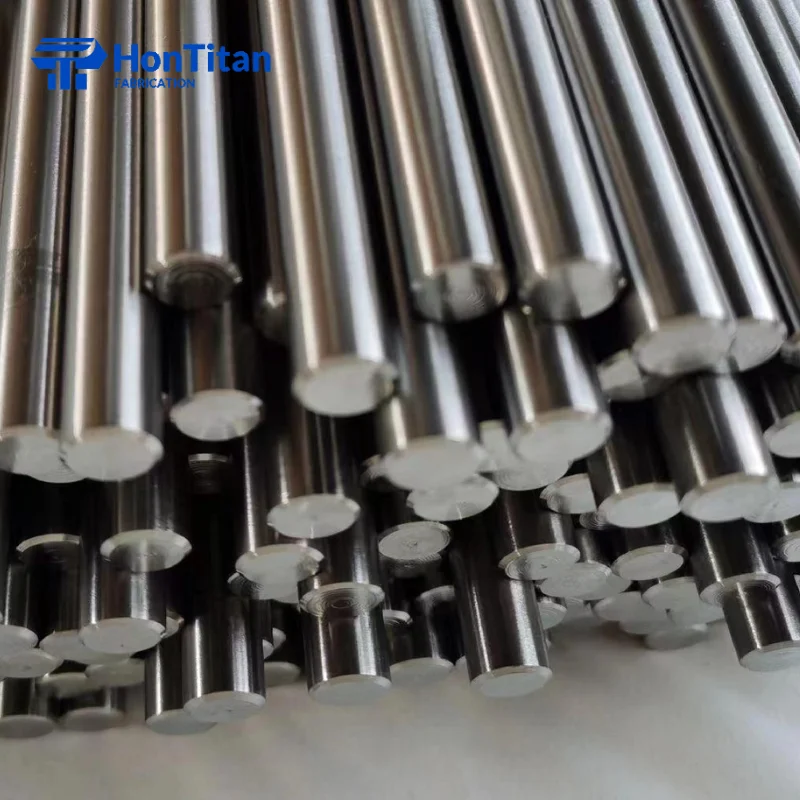
산소와의 극단적인 반응성으로 인해 티타늄은 대부분의 용도에서 일반적인 사형 주조가 비실용적입니다 — 용융 티타늄은 대기 중에서 발화합니다. 지배적인 방법은 진공 인베스트먼트 주조, 이며, 이는 로스트왁스 세라믹 셸 공정과 밀폐된 진공 챔버 및 수냉식 구리 스컬 용해로를 결합한 방식입니다. 진공 다이 주조 및 원심 주조를 포함한 기타 방법은 제한적인 틈새 시장에서 사용됩니다. 이 가이드는 실행 가능한 모든 티타늄 주조 방법을 상세히 설명하고, 필수적인 진공 요건을 설명하며, 공정 경제성을 비교하고, 항공우주 및 의료 구매자들이 예산 책정 시 지속적으로 간과하는 후처리 단계(HIP, 알파케이스 제거, 열처리)를 다룹니다。.
티타늄 주조가 다른 금속과 근본적으로 다른 이유
대부분의 금속은 대기 중에서 사형 틀에 녹여 부을 수 있습니다。 티타늄은 그렇지 않습니다。.
대략 1100°C 이상의 온도에서 용융 티타늄은 산소 및 질소와 격렬하게 반응합니다。 대기 가스가 용탕 내로 용해되어 취성의 산소 농화 표면층인 알파 케이스 이 형성되며 — 심각한 노출의 경우 금속이 발화할 수 있습니다。 이것은 단순한 취급상의 불편함이 아닙니다。 이는 강철, 알루미늄, 심지어 니켈 초합금에도 완벽하게 적용되는 전체 주조 방법 범주를 배제하는 야금학적 현실입니다。.
그 결과: 사실상 모든 실행 가능한 티타늄 주조 방법은 진공 또는 제어된 불활성 분위기 환경을 필요로 합니다。. 이 단일 제약 조건이 장비, 공구, 사이클 타임, 공급업체 자격 인증, 비용 등 모든 것을 재편합니다。.
처음부터 이를 이해하면 티타늄에 적합한 인프라를 갖추지 못한 “주조를 한다'는 주조 업체와의 낭비적인 RFQ 사이클을 방지할 수 있습니다。.
네 가지 주요 주조 방법과 티타늄 호환성
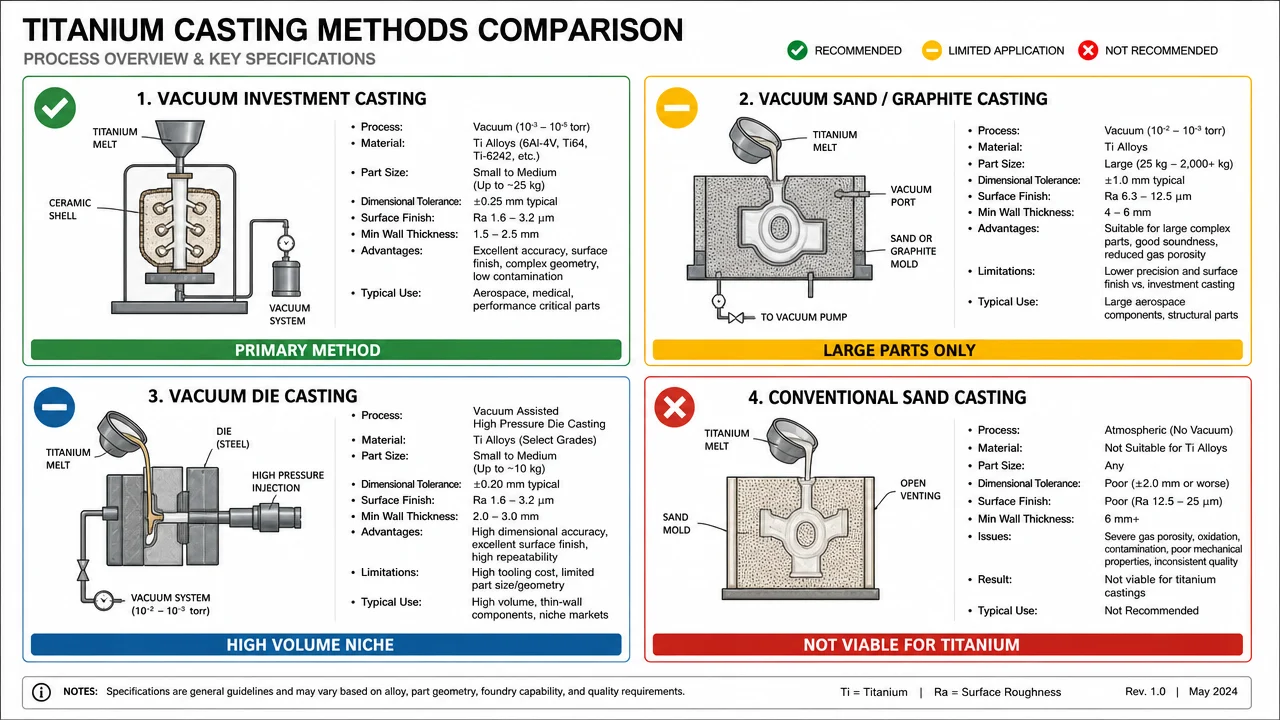
| 방법 | 티타늄 호환 여부? | 이유 / 비호환 이유 |
|---|---|---|
| 진공 인베스트먼트 주조 | ✅ 예 — 주요 방법 | 밀폐된 진공 챔버 + 세라믹 셸이 대기 오염을 방지합니다 |
| 진공 다이 주조 | ✅ 예 — 제한적 틈새 | 고압 진공 다이 주조가 실행 가능하며、전문 장비가 필요합니다 |
| 원심 주조 | ✅ 예 — 전문화됨 | 링 및 튜브에 사용;진공 환경 필요 |
| 사형 주조 | ⚠️ 심각하게 제한됨 | 일반 사형 주조는 심각한 알파케이스를 유발함;진공 사형 주조가 존재하나 티타늄에는 거의 사용되지 않음 |
| 중력 금형 주조(영구 금형) | ❌ 실행 불가 | 용융 티타늄이 강철 또는 철 공구와 반응함 |
| 표준 다이 캐스팅 | ❌ 실행 불가 | 사출 압력이 티타늄의 반응성과 양립 불가;진공 제어 불가 |
이 가이드의 나머지 부분은 실제로 사용되는 세 가지 실용적인 방법,즉 진공 인베스트먼트 주조,진공 다이 캐스팅,그리고 적용 가능한 경우 티타늄 사형 주조에 초점을 맞춥니다。.
진공 인베스트먼트 주조:지배적인 티타늄 공정
진공 인베스트먼트 주조(진공 로스트왁스 주조라고도 함)는 상업용 티타늄 주조품의 85–90%를 처리합니다。이 방법은 대부분의 주조 업체가 자격 없이 「티타늄 주조」라고 말할 때 의미하는 방법입니다。.
지배적인 이유: 인베스트먼트 주조의 니어 넷 셰이프 가공 능력은 가공 비용이 높고 어려운 소재의 주조 후 기계 가공을 최소화합니다。세라믹 셸은 티타늄의 높은 용융점(1668°C / 3034°F)를 견딥니다。또한 이 공정은 본질적으로 배치 확장이 가능하여,하나의 진공 용광로 가동으로 수십 개의 부품을 동시에 주조할 수 있습니다。.
진공 인베스트먼트 주조 공정,단계별 안내
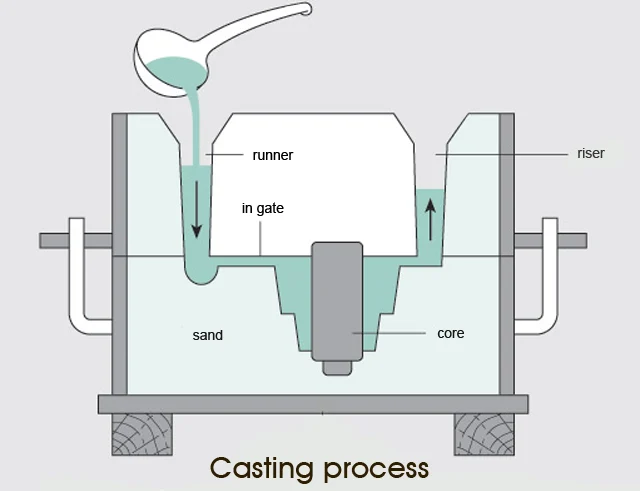
1. 패턴 제작
목표 부품의 왁스 또는 열가소성 패턴은 정밀 가공된 툴링을 사용하여 사출 성형됩니다。고정밀 공차 항공우주 부품의 경우,사출 툴링으로 인한 치수 편차를 제거하기 위해 CNC 가공 왁스 패턴이 점점 더 보편화되고 있습니다。.
2. 셸 제작
패턴을 세라믹 슬러리에 반복적으로 침지하고 내화 모래로 코팅합니다。티타늄의 경우 특히,표준 실리카 기반 셸은 부적합합니다 — 용융 티타늄이 실리카(SiO₂)를 환원시켜 용탕을 오염시키기 때문입니다。업계 표준은 이트리아 안정화 지르코니아(YSZ) 또는 칼시아 안정화 지르코니아 페이스 코트를 사용하며,이는 액체 티타늄에 화학적으로 불활성입니다。일반적인 티타늄 셸은 8~12회의 침지 코팅을 거치며 벽 두께 두께 8~12mm에 달합니다。.
3. 탈왁스 및 예열
셸 몰드를 가열하여 왁스 패턴을 소각하면 속이 빈 세라믹 공동이 남습니다。몰드는 주입 전 150~300°C로 예열하여 충전성을 향상시키고 열 충격을 줄입니다。.
4. 전극 준비
티타늄 주조 공장은 일반적인 장입 재료 대신 소모성 전극 — 아크 용해 공정에서 원료이자 양극 역할을 하는 압착된 티타늄 합금 봉 — 을 사용합니다。전극의 조성은 목표 합금 규격(예:Ti-6Al-4V 주조품의 경우 AMS 4991)과 일치해야 합니다。.
5. 진공 챔버 장입 및 배기
예열된 세라믹 셸과 티타늄 전극을 주조 챔버에 장입합니다。챔버를 밀봉하고 고진공 — 일반적으로 10⁻³ mbar 미만 — 상태로 배기하여,가열 시작 전에 대기 중 산소와 질소를 제거합니다。.
6. 스컬 용해(VAR 공정)
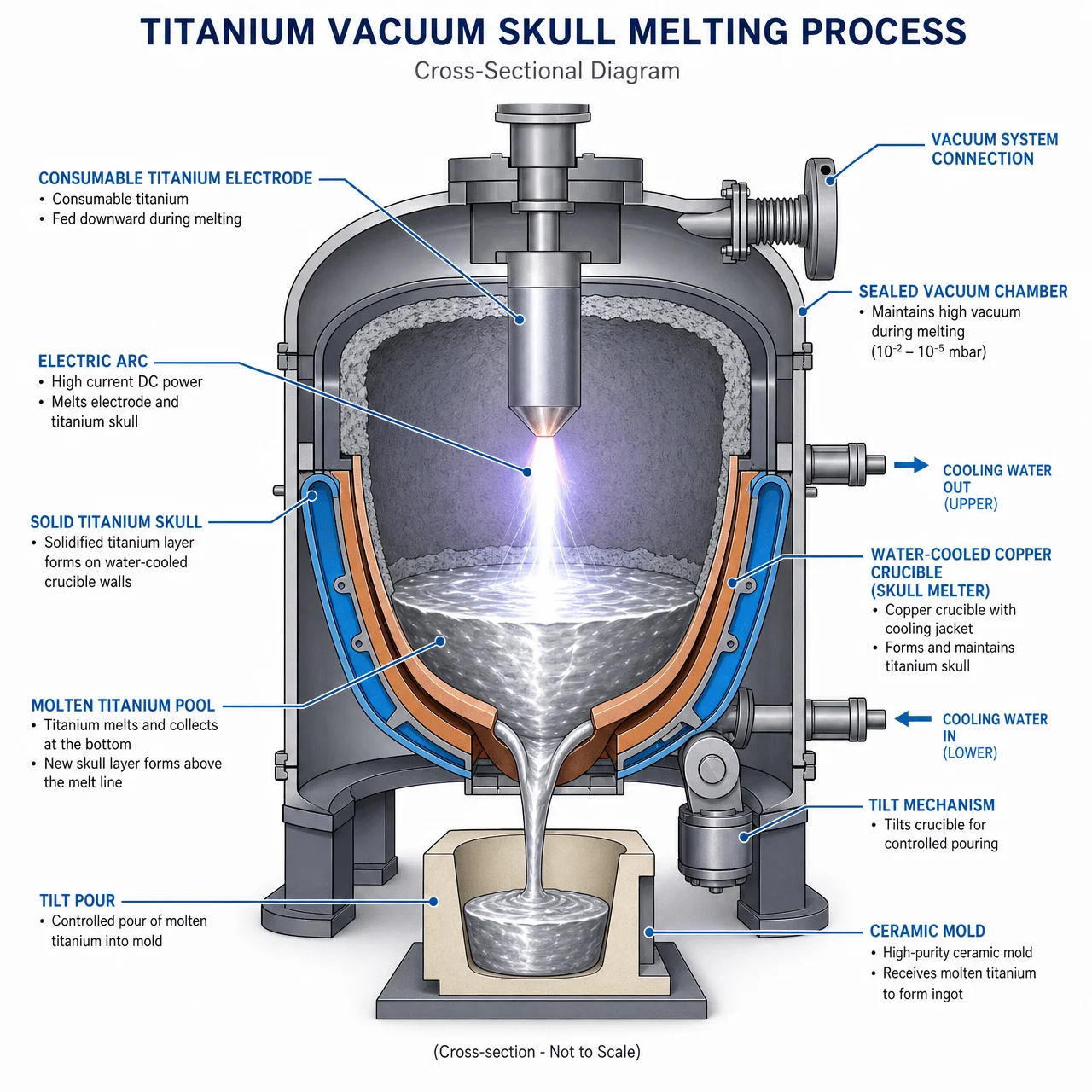
이 단계는 티타늄을 다른 인베스트먼트 주조 금속과 가장 뚜렷하게 구별하는 과정입니다。용융 티타늄이 산화물 세라믹과 반응하기 때문에,일반 세라믹 도가니 대신 수냉식 동 도가니(스컬 멜터) 를 사용합니다。전기 아크가 소모성 전극과 도가니 내 소량의 시작 재료 사이에서 발생합니다。티타늄은 전극 팁에서 용해되어 수냉식 동 보울에 고입니다。.
The outer layer of the titanium pool solidifies against the copper walls — forming the “skull” — while the interior remains liquid. This skull of solid titanium physically prevents contact between the molten pool and the copper. Temperatures in the melt pool exceed 1700°C.
7. Tilt Pour or Centrifugal Pour
Once the required melt volume is achieved, the chamber tilts (or a centrifuge mechanism engages) to pour molten titanium into the preheated shell. The entire pour happens within the sealed vacuum environment. Centrifugal casting variants spin the shell at 200–500 RPM during pouring to improve fill of thin sections.
8. Controlled Cooling and Shell Removal
Castings cool in the vacuum or inert atmosphere before the chamber is opened. Ceramic shell is removed by mechanical knockout, vibratory decladding, or high-pressure water blasting.
9. Cutoff and Initial Inspection
Gates and risers are removed. Initial dimensional inspection and visual inspection follow. For aerospace applications, first-article inspection typically includes coordinate measuring machine (CMM) dimensional verification.
What Tolerances Can You Expect?
Titanium investment castings typically achieve:
- Linear dimensional 공차: ±0.005 in/in (±0.13 mm/mm) per ASTM B372 / industry practice
- Surface finish: Ra 1.6–3.2 µm (63–125 µin) as-cast — significantly better than sand casting
- Minimum 벽 두께: 1.5–2mm for most alloys
These tolerances assume proper tooling design and shell quality. Complex internal passages, cores, or thin sections require design-for-manufacturing review.
Titanium Sand Casting: When It Works and When It Doesn’t
Sand casting is the world’s most common metal casting process — but titanium makes it far more complicated than casting iron or steel.
The fundamental problem: conventional silica sand contains SiO₂ (silicon dioxide). At titanium casting temperatures, molten titanium aggressively reduces SiO₂, pulling oxygen into the melt and depositing silicon contamination. The result is a brittle, oxygen-enriched alpha-case layer on the casting surface that can extend several millimeters deep, requires aggressive chemical milling to remove, and represents a structural liability in load-bearing applications.
This is why the common statement “sand casting can be used for titanium” is technically true but practically misleading for most engineering applications.
Where Titanium Sand Casting Is Actually Used
Titanium sand casting does exist — but it uses non-reactive refractory aggregates, not conventional silica sand. Viable mold materials include:
- Graphite molds (most common for larger titanium parts)
- CaO-stabilized zirconia aggregate
- Calcia (CaO) or yttria (Y₂O₃) face-coat sand molds
And the entire process still requires a vacuum or inert-atmosphere environment for melting and pouring. Open-air titanium sand casting is not viable at production quality.
In practice, titanium “sand casting” (usually graphite mold casting) is used for:
- Large structural aerospace parts (wing carry-through structures, fuselage frames) where the geometry is too large for standard investment casting equipment
- Parts up to 500 kg where investment casting tooling costs are prohibitive
- Low-volume or prototype parts where shell tooling isn’t justified
Trade-offs vs. investment casting:
| 매개변수 | 진공 인베스트먼트 주조 | Vacuum Sand/Graphite Casting |
|---|---|---|
| Surface finish (as-cast) | Ra 1.6–3.2 µm | Ra 6.3–12.5 µm (rougher) |
| Dimensional 공차 | ±0.005 in/in | ±0.010–0.015 in/in |
| Max part size | ~25–50 kg (typical equipment) | 500+ kg feasible |
| 툴링 비용 | Moderate (wax/ceramic tooling) | Lower (graphite machining) |
| Alpha-case depth | 0.1–0.3 mm (ceramic shell) | 0.3–0.8 mm (graphite mold) |
| 대표적인 적용 분야 | Aerospace brackets, medical implants, industrial valves | Airframe structures, large pump casings |
The key takeaway: for any precision or structural titanium casting under ~50 kg, vacuum investment casting delivers better dimensional control and surface finish at comparable cost. Graphite mold casting becomes the practical choice when part size exceeds standard investment casting furnace capacity.
Vacuum Die Casting for Titanium: The High-Pressure Alternative
Vacuum die casting of titanium occupies a narrow but real niche, primarily studied and commercialized in the 1990s–2000s as a route to lower-cost titanium components. Research at ORNL and other institutions demonstrated that vacuum die casting can produce near-net-shape titanium parts with wall thicknesses down to 1mm at cycle times much faster than investment casting.
How it differs from conventional die casting:
- The die cavity is evacuated before injection
- Tooling must be compatible with titanium’s reactivity (specialized die coatings or materials)
- Shot speeds and pressures are modified to prevent turbulence that entraps gas
The catch: titanium’s high 용융점 (1668°C) and reactivity with most tool steels makes die longevity a persistent challenge. Standard H13 tool steel dies used for aluminum die casting are not suitable — titanium solders to them and erodes them rapidly. This has limited widespread commercial adoption.
Where vacuum die casting for titanium currently sees use:
- High-volume consumer/automotive Ti components where investment casting tooling amortization is slow
- Thin-wall structural shapes that investment casting struggles to fill consistently
For most aerospace and medical procurement engineers, vacuum investment casting remains the default and the safe choice.
Post-Processing: The Part of Titanium Casting That Surprises Buyers
One of the most common budget surprises in titanium procurement: the casting itself is only part of the cost. Aerospace and medical applications require additional processing steps that add 30–70% to the part cost.
열간 등방성 프레싱(HIP)
Titanium investment castings contain micro-porosity from gas entrapment and solidification shrinkage. For structural applications, this porosity must be eliminated. HIP subjects the casting to simultaneous high temperature (~900–950°C) and high isostatic pressure (100–175 MPa / ~15,000–25,000 PSI) in an inert argon atmosphere. This collapses internal voids without changing external dimensions.
HIP is mandatory for flight-critical aerospace castings and for load-bearing medical implants. It is not optional if your part specification calls out AMS 2175 (castings standard) or AMS 2801 (heat treatment). Budget approximately 15–25% cost addition for HIP.
Alpha-Case Removal
Even with a good vacuum, the outermost surface of titanium castings develops a brittle, oxygen-enriched alpha-case layer. For investment castings with yttria-stabilized zirconia shells, this layer is typically 0.05–0.2 mm thick. For graphite mold castings, it can reach 0.5–1.0 mm.
Alpha case must be removed before the part is used in structural applications. Methods:
- Chemical milling (acid etching): Most common; HF/HNO₃ solutions dissolve the surface layer uniformly
- Mechanical removal: Electrochemical machining (ECM) or controlled abrasive blasting in some configurations
NADCAP-certified processing is standard for aerospace applications.
열처리
Ti-6Al-4V and other alpha-beta alloys typically receive a stress relief anneal or full solution treat + age cycle after casting to achieve target mechanical properties. Required parameters are alloy-specific and specified in AMS 2801 or the customer’s engineering specification.
NDT Requirements
Aerospace castings commonly require:
- X-ray or CT scanning (ASTM E1742 / MIL-STD-453)
- Fluorescent penetrant inspection (FPI per ASTM E1417)
- Chemical analysis (per-heat traceability to AMS or ASTM spec)
These add cost but are non-negotiable for flight hardware. Medical implants add biocompatibility certification requirements (ISO 10993, ASTM F136 for implant-grade Ti-6Al-4V 초저간극).
Selecting the Right Titanium Casting Method: A Decision Framework
The right casting method depends on four variables: part size, required 공차, production volume, and application criticality.
| 결정 요인 | 진공 인베스트먼트 주조 | Graphite/Sand Mold Casting | 진공 다이 주조 |
|---|---|---|---|
| Part weight | <25–50 kg | Up to 500+ kg | <5 kg (typical) |
| 공차 requirement | Tight (±0.005 in/in) | Moderate (±0.010–0.015) | Tight (±0.003–0.005) |
| Surface finish priority | 높음 | Low-moderate | 높음 |
| 볼륨 | Low to medium | 낮음 | Medium to high |
| Geometric complexity | High — thin walls, internal passages | Low-moderate | Moderate — thin walls |
| Aerospace/medical certifiable | Yes — industry standard | Yes — for large structures | Limited — less established |
| Relative tooling cost | 보통 | 낮음 | High (die cost) |
Practical selection rules:
- Part under 25 kg + complex geometry + aerospace/medical = 진공 인베스트먼트 주조
- Part over 100 kg + simpler geometry + cost-sensitive = vacuum graphite mold casting
- High-volume + thin wall + consumer/automotive = vacuum die casting (if supplier is qualified)
- “Can we sand cast this titanium bracket?” from a conventional foundry = 아니요 — redirect to vacuum investment casting
Titanium Casting Grades: Which Alloy to Specify
Three titanium grades represent approximately 95% of castings in production:
CP Titanium 2등급 (Commercially Pure)
- Density: 4.51 g/cm³; 인장 강도: ~345 MPa as-cast
- Standards: ASTM B367, ASME SB367, ASTM F67 (for medical)
- Best for: Maximum 내식성 applications — chemical process equipment, marine hardware, non-structural medical housings
- Don’t use for: Any load-bearing structural application
Ti-6Al-4V (5등급 / AMS 4991)
- Density: 4.43 g/cm³; 인장 강도: 895–930 MPa (as-cast, post-HIP)
- Standards: AMS 4991 (casting), ASTM F136 (implant-grade 초저간극 variant)
- Best for: Aerospace brackets, engine mounts, orthopedic implants, racing components
- Note: “Ti-6Al-4V” and “ASTM F136” are not interchangeable — medical implants require the 초저간극 (Extra Low Interstitial) variant with tighter oxygen/nitrogen/hydrogen limits
Ti-6Al-2Sn-4Zr-2Mo (Grade 6 / AMS 4999)
- Density: 4.54 g/cm³; significantly higher 크리프 resistance than Gr 5
- Standards: AMS 4999
- Best for: Jet engine stators, high-temperature actuators, components with sustained loads above 315°C (600°F)
- Cost: 2–3× Ti-6Al-4V; only justified when operating temperature demands it
Real Cost Ranges for Titanium Castings
Cost transparency is rare in titanium casting. Based on supplier data and industry benchmarks:
| Component Type | 합금 | Rough Cost Range | Key Cost Driver |
|---|---|---|---|
| Simple valve body (50–200g) | CP Gr 2 | $800–$1,500/unit | Small volume, vacuum overhead |
| Aerospace bracket (0.5–2 kg) | Ti-6Al-4V | $1,800–$3,500/unit | HIP + X-ray + cert requirements |
| Medical hip stem (0.3–0.8 kg) | Ti-6Al-4V ELI | $4,000–$7,500/unit | ASTM F136 cert + electropolishing |
| Large structural frame (10–25 kg) | Ti-6Al-4V | $8,000–$25,000/unit | Furnace cycle cost, post-processing |
Raw material cost for Ti-6Al-4V is approximately $80–$120/kg for casting-grade sponge/electrode. But material is typically only 25–40% of total part cost — vacuum processing overhead, specialty ceramics, HIP, NDT, and certification compliance dominate.
The rule of thumb: titanium castings cost 5–10× equivalent stainless steel castings and 15–20× equivalent aluminum castings. This premium is justified when the application demands the strength-to-weight ratio, 내식성, or biocompatibility that titanium uniquely provides.
Qualifying a Titanium Casting Supplier: What to Ask
Most foundries cannot produce titanium castings. The equipment investment — vacuum arc melting furnaces, copper skull melters, yttria shell systems — runs $2–5M+, and the process expertise takes years to develop. Before sending an RFQ, verify:
Equipment:
- Does the foundry have its own vacuum arc remelting (VAR) or skull melting equipment? (Not outsourced)
- What is the maximum furnace capacity (kg per heat)?
- Is HIP done in-house or at a NADCAP-certified subcontractor?
인증:
- AS9100 Rev D (aerospace quality management) for aerospace parts
- NADCAP accreditation in casting (AC7102) and applicable special processes
- ISO 13485 for medical device applications
- Per-heat material traceability to AMS 4991 or ASTM F136
Process Controls:
- What ceramic shell system do they use? (Answer should reference yttria or calcia face coats — not generic silica)
- What vacuum level is achieved before pour? (Should be sub-10⁻³ mbar)
- What is their documented scrap rate for titanium? (Expect 10–20% for complex parts; significantly higher is a red flag)
Red flags: “We occasionally do titanium” / no dedicated vacuum furnace / generic material certs not tied to heat numbers.
자주 묻는 질문
Can titanium be sand cast?
Titanium can be cast in graphite or calcia/yttria-stabilized sand molds, but conventional silica sand reacts with molten titanium and is not suitable. Any titanium sand or graphite mold casting still requires a vacuum or inert-atmosphere environment for the melt and pour. For most precision applications under 50 kg, vacuum investment casting offers better results.
Why does titanium casting require a vacuum?
Molten titanium reacts aggressively with oxygen and nitrogen at its casting temperature (above 1668°C). These reactions form brittle interstitial phases and an alpha-case surface layer that compromises mechanical properties. A vacuum environment prevents atmospheric exposure during melting and pouring.
What is alpha case in titanium casting?
Alpha case is a brittle, oxygen-enriched surface layer that forms when molten titanium contacts oxygen or nitrogen. It is harder than the bulk material and has significantly reduced 연성 and fatigue life. For structural applications, alpha case must be removed by chemical milling (acid etching) before part acceptance.
What is HIP and why is it required for titanium castings?
Hot Isostatic Pressing (HIP) uses simultaneous heat (~900°C) and high inert gas pressure (~175 MPa) to collapse internal micro-porosity in the casting. For aerospace and load-bearing medical applications, the internal integrity HIP provides is a specification requirement, not a supplier option.
Is Ti-6Al-4V the best alloy for titanium castings?
For most applications, yes. Ti-6Al-4V (AMS 4991) offers the best combination of strength, castability, and available certification data. CP Gr 2 is preferred when maximum 내식성 matters more than strength. Ti-6Al-2Sn-4Zr-2Mo (AMS 4999) is only justified for high-temperature applications above ~315°C sustained service temperature.
How long does titanium investment casting typically take from order to shipment?
Lead times for aerospace/medical titanium castings typically run 12–20 weeks for new parts (including tooling production, first-article inspection, and post-processing). Repeat production of qualified parts can be 8–12 weeks. This is significantly longer than aluminum or steel investment casting due to the complexity of post-processing and qualification requirements.
요약
Titanium’s reactivity with oxygen is the defining fact of all titanium casting — it eliminates conventional sand casting, open-pour die casting, and any method that exposes molten metal to air. Vacuum investment casting using copper skull melters and yttria-stabilized ceramic shells is the industry-standard process because it handles complex geometries at near-net-shape precision while keeping the melt in a sealed vacuum environment.
Sand/graphite mold casting remains viable for large titanium structures that exceed standard investment casting furnace capacity, but requires the same vacuum environment and produces rougher surfaces and wider tolerances. Vacuum die casting handles niche high-volume thin-wall applications.
For buyers: the part cost is only the beginning. Budget for HIP, alpha-case removal, heat treatment, and NDT — these post-processing steps are mandatory for aerospace and medical parts and add 30–70% to casting cost. Verify your supplier’s equipment and certifications before sending drawings.