Titanium is strong but not hard. In Rockwell C terms, Grade 5 titanium (Ti-6Al-4V) sits at HRC 30–34 in the annealed condition and HRC 35–39 after solution-treated-and-aged (STA). That is softer than most stainless steels and much softer than hardened tool steels. The trade-off is a strength-to-weight ratio roughly twice that of steel and natural corrosion resistance titanium gains from its titanium dioxide (TiO₂) surface layer. If you need wear resistance, plan a surface treatment such as nitriding or PVD coating.
Why “Hardness” and “Strength” Get Confused
Hardness measures resistance to surface deformation — how easily a metal scratches or indents under a fixed load. Tensile strength measures how much pull a bar can take before breaking. The two properties do not track together.
Titanium Grade 5 (Ti-6Al-4V) has a tensile strength of approximately 895–950 MPa (annealed, ASTM B348 minimum) to 1100–1170 MPa (STA) per MatWeb and TIMET data, which is comparable to medium-strength steels like AISI 4140. But its Rockwell C hardness is only 30–34 (annealed), while 4140 in the quenched-and-tempered condition reaches HRC 38–42. This is why a titanium aerospace bracket will not bend under flight loads, yet its surface will pick up scuffs on a tool bench.
Understanding the Hardness Scales
Before comparing numbers, it helps to know which test you are looking at.
Rockwell B (HRB) measures soft to medium materials using a 1/16-inch steel ball and 100 kgf. Values typically range from 50 HRB (soft aluminum) to 100 HRB (mild steel).
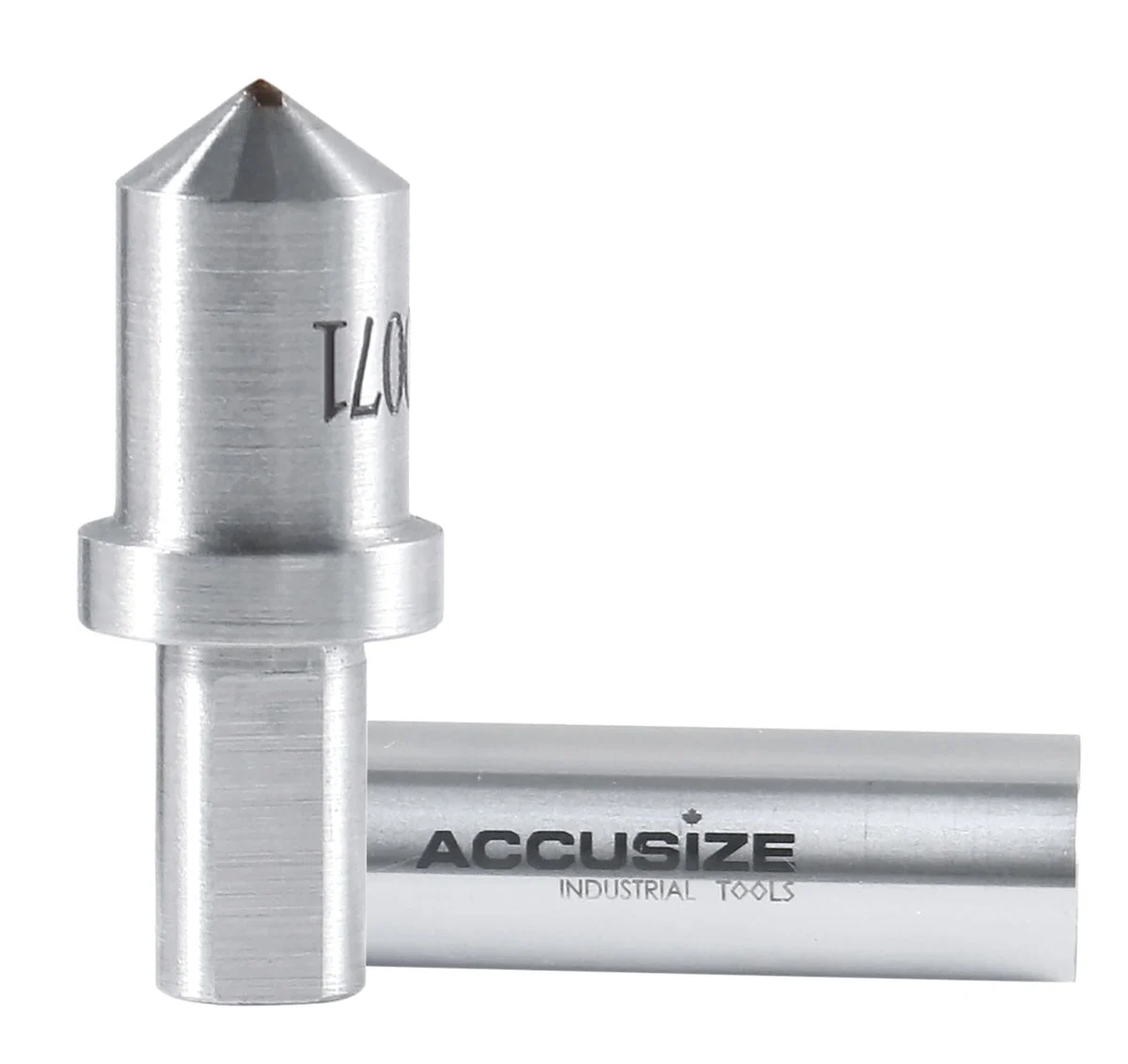
Rockwell C (HRC) measures harder materials using a diamond cone and 150 kgf. Titanium grades above about 300 HB tend to be quoted in HRC rather than HRB, since HRB tops out around 100.
Brinell (HB) presses a 10 mm steel ball into the surface under 3000 kgf. It gives a broad average across a relatively large area and is common in structural steel.
Vickers (HV) uses a diamond pyramid indenter. It is used more in research and for thin-surface treatments such as nitrided layers.
Conversion tip: HRC and Brinell are related but not linear. ASTM E140 provides official conversion tables, but for accuracy, always measure directly rather than converting when tolerances matter.
Titanium Grade 1–5 Hardness Values
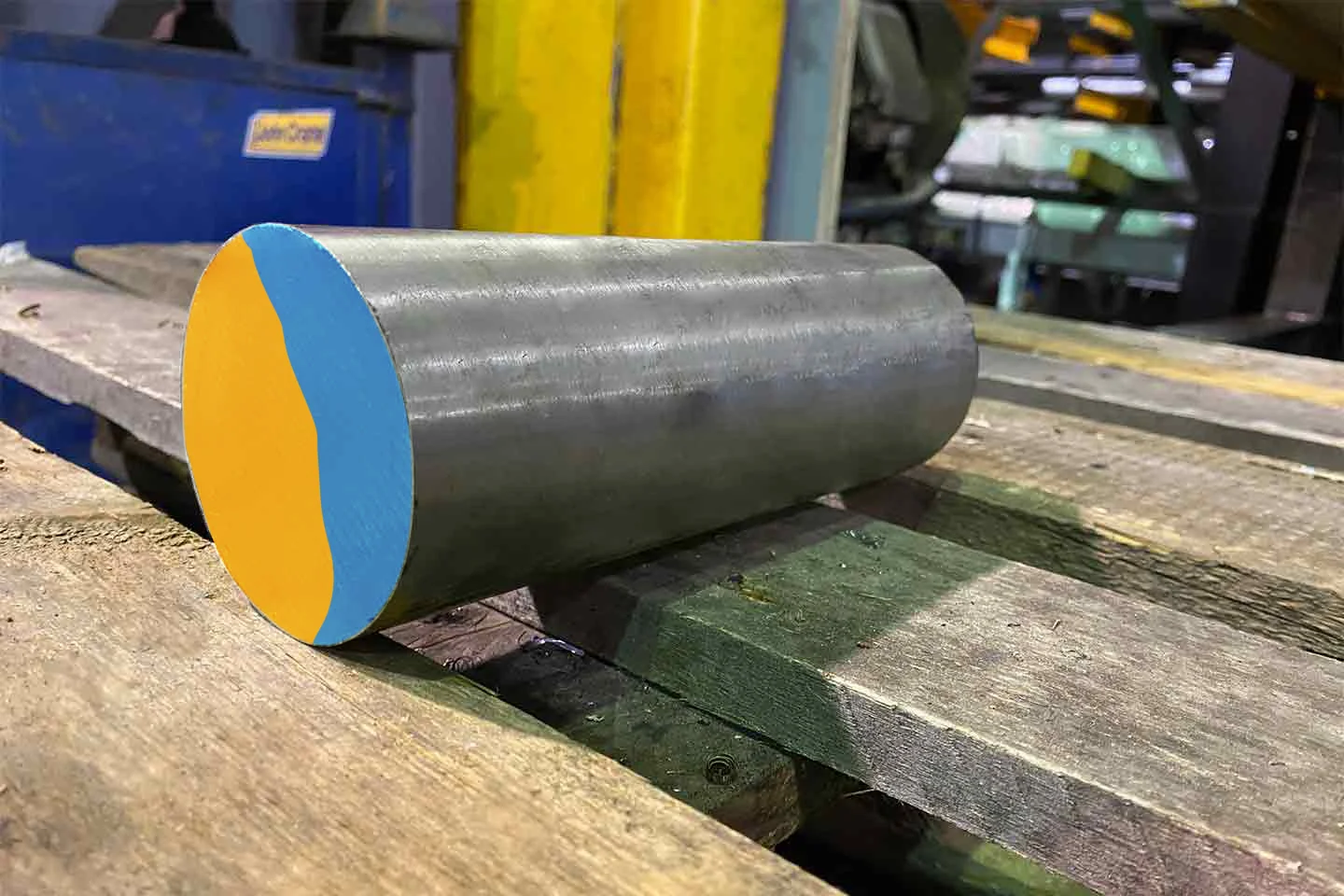
The grades below are for annealed condition unless otherwise noted. Annealed means the material was heated to approximately 700–790 °C, held for a short time, and air-cooled to stabilize the microstructure.
| Grade | Common Name | HB | HV | HRB | HRC | Tensile Strength (MPa) | Typical Use |
|---|---|---|---|---|---|---|---|
| Grade 1 | CP Ti (softest) | 120 | 122 | 70 | — | 330 | Chemical tanks, heat exchangers |
| Grade 2 | CP Ti (standard) | 145 | 145 | 80 | — | 345 | Marine, desalination |
| Grade 3 | CP Ti (strong) | 185 | 186 | 90 | — | 450 | Pressure vessels |
| Grade 4 | CP Ti (highest strength) | 235 | 238 | 96 | 18 | 550 | Airframe skin, surgical instruments |
| Grade 5 | Ti-6Al-4V | 334 | ~335 | — | 30–34 (annealed) | 895 (min) | Aerospace, implants, marine |
After solution-treated-and-aged (STA): Grade 5 can reach HRC 35–39 and a Brinell hardness above 380 HB. The STA cycle typically involves solution treating at 925–970 °C, water quenching, then aging at 480–590 °C for 4–8 hours per TIMET and ATI specifications.
Sources: MatWeb (ASM), ATI Grade 5 datasheet (atimaterials.com), Kyocera SGS Europe titanium properties page.
How Hard Is Grade 5 Titanium on the Rockwell C Scale?
This is the most commonly searched question for Grade 5, so here is the direct answer.
Annealed condition: Rockwell C 30–34. This is the standard condition for most commercially available Grade 5 bar, sheet, and plate.
STA (solution-treated-and-aged): Rockwell C 35–39. Higher hardness comes with reduced ductility — elongation drops from approximately 14% to 10% per the ATI datasheet.
Cold-worked: Can reach HRC 36–40 but with even lower elongation (typically under 8%).
Context: A 304 stainless steel knife blade in the annealed condition is roughly HRB 80 (about HRC 15–20). A hardened 440C stainless knife reaches HRC 58–60. A Grade 5 titanium frame or knife body at HRC 30–34 will outlast stainless in corrosion but lose a scratch-resistance contest badly against 440C.
Hardness Conversion Table: Titanium vs. Common Steels
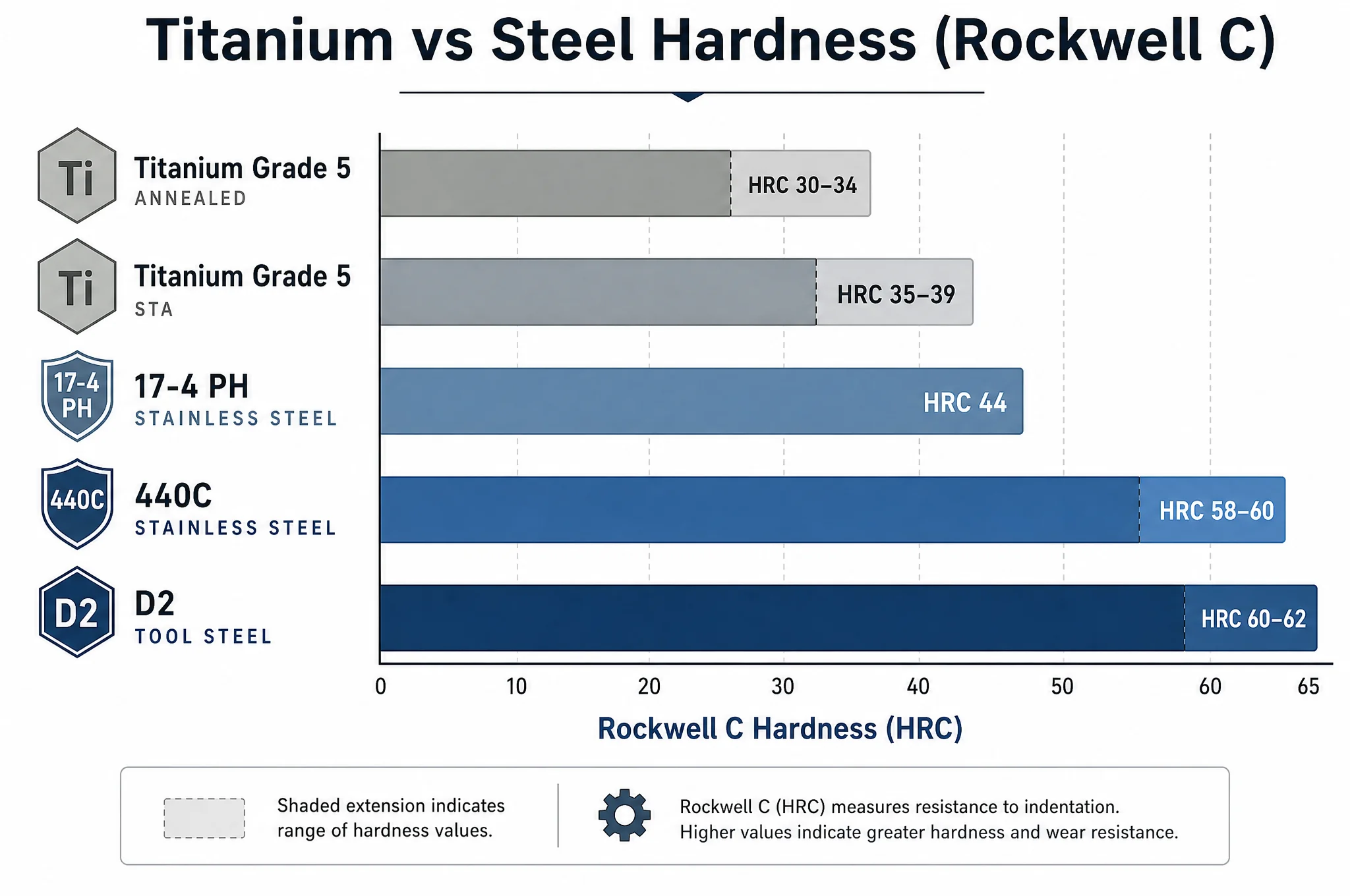
This table converts hardness values across scales, based on ASTM E140 approximate conversions.
| Material | Condition | HB | HV | HRB | HRC |
|---|---|---|---|---|---|
| Titanium Grade 1 | Annealed | 120 | 122 | 70 | — |
| Titanium Grade 2 | Annealed | 145 | 145 | 80 | — |
| Titanium Grade 5 | Annealed | 334 | ~335 | — | 30–34 |
| Titanium Grade 5 | STA | 380+ | 400+ | — | 35–39 |
| 304 Stainless Steel | Annealed | 149 | 152 | 79 | — |
| 316 Stainless Steel | Annealed | 146 | 152 | 80 | — |
| 17-4 PH Stainless | H900 | 420 | 440 | — | 40–44 |
| AISI 4140 | Q&T | 380 | 400 | — | 38–42 |
| AISI 4340 | Q&T | 363 | 385 | — | 36–40 |
| 440C Stainless | Hardened | — | 697 | — | 58–60 |
| Tool Steel (D2) | Hardened | 621 | ~748 | — | 60–62 |
Key takeaway: Grade 5 titanium in the annealed condition is about 10–15 HRC points below medium-strength steels and 25–30 HRC points below tool steels. This is a meaningful difference for any wear-critical application. Note: Brinell values above ~500 HB are less reliable, as the standard 10 mm ball indenter begins to flatten at very high hardness levels.
Why Titanium Scratches Easily — The Metallurgy
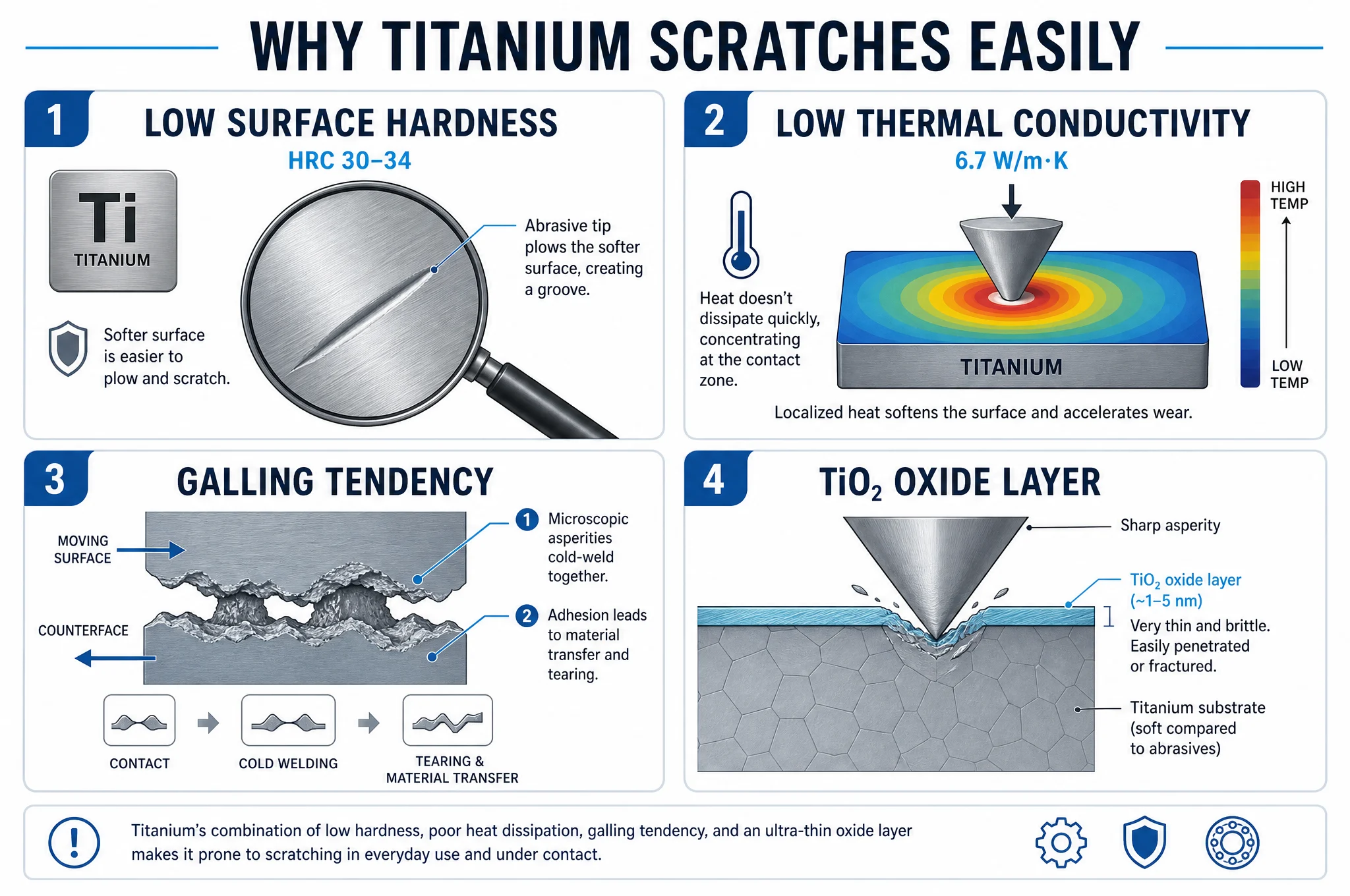
There are four reasons titanium’s surface loses to steel in scratch tests, and none of them relate to strength.
1. Low surface hardness. As shown above, Grade 5 sits at HRC 30–34. Anything below HRC 40 will lose a scratch test to most hardened steels.
2. Low thermal conductivity. Titanium conducts heat at approximately 6.7 W/m·K, compared to 16.2 W/m·K for 316 stainless steel and 49.8 W/m·K for plain carbon steel. During machining or cutting, heat concentrates at the contact point instead of dissipating. This accelerates tool wear and makes the surface more susceptible to localized deformation.
3. Galling tendency. Titanium has a strong tendency to cold-weld (gall) to itself and to other metals under sliding contact. The TiO₂ layer that protects against corrosion breaks down under friction, and the bare titanium surface bonds to adjacent metal. This is why titanium bolts need anti-seize and why titanium-on-titanium bearings are avoided.
4. Passivation oxide layer. The TiO₂ layer is only a few nanometers thick. It is excellent for corrosion resistance but provides zero mechanical protection against scratches. Once scratched, the layer reforms — but the scratch itself is permanent in the underlying metal.
Titanium vs. Steel: Hardness Head-to-Head
| Property | Grade 5 Ti (Annealed) | 316 SS (Annealed) | 4140 Steel (Q&T) | 440C SS (Hardened) |
|---|---|---|---|---|
| Brinell (HB) | 334 | 146 | 380 | — |
| Rockwell C | 30–34 | ~18 (HRB 80) | 38–42 | 58–60 |
| Tensile (MPa) | 895 | 515 | 1020 | ~1970 |
| Density (g/cm³) | 4.43 | 8.00 | 7.85 | 7.75 |
| Strength-to-weight | ~202 | ~64 | ~130 | ~254 |
| Corrosion resistance | Excellent | Good | Fair (needs coating) | Fair |
Plain-language conclusion: Steel wins on hardness. Titanium wins on the combination of strength, light weight, and corrosion resistance. There is no scenario where titanium is “harder than steel” in absolute terms. The marketing claim that titanium is harder is incorrect, and repeating it in spec sheets or blog posts damages credibility with engineering audiences.
Hardening Titanium: Can You Increase the Surface?
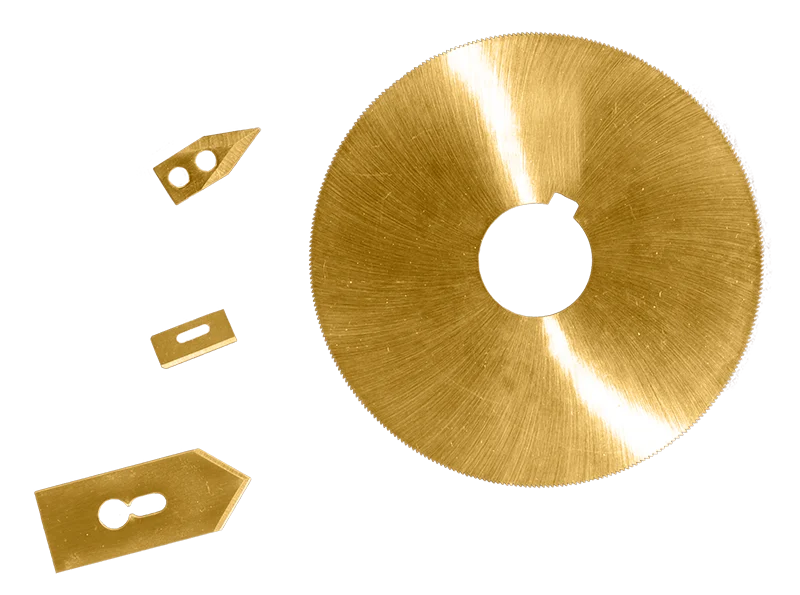
Yes, through surface treatments, not through bulk metallurgy the way you harden steel. You cannot quench and temper titanium the way you harden 1095 carbon steel.
Nitriding: Introduces nitrogen into the surface at 700–900 °C. Produces a case depth of 10–50 μm with a surface hardness of 900–1200 HV (about HRC 67–72 equivalent). Research published in ScienceDirect (2016) confirms measurable wear resistance improvement on Ti-6Al-4V via gas nitriding.
Carburizing: Introduces carbon at 850–950 °C. A 2024 review in MDPI Coatings found that carburizing creates a TiC (titanium carbide) layer with hardness commonly reported at 2500–3200 HV (literature range for TiC) in test samples, dramatically improving wear resistance.
Shot peening: Creates compressive residual stress on the surface, which improves fatigue life. In terms of surface hardness, an ASME study found that shot peening increased Ti-6Al-4V surface hardness from approximately 335 HV to 500–620 HV, depending on intensity and coverage — significant improvements for fatigue-sensitive applications.
TiN PVD coatings (TiN, TiAlN, DLC): Deposits a thin, extremely hard film. TiN (titanium nitride) coatings reach 2300–3000 HV and are standard on cutting tools and watch cases (eifeler: 2300 HV typical; BryCoat: 2500–3000 HV typical).
Expanite® (interstitial hardening): A proprietary process that produces an alpha-case with hardness of approximately 900 HV to a depth of 10–30 μm, per Expanite’s published ASTM G133 wear test results.
The Real-World Scratch Test: What Users Actually Experience
Across Reddit threads in r/Watches, r/GrandSeikos, and r/CitizenWatches, the consistent report is: titanium watches show scratches faster than stainless steel watches under identical daily wear conditions. Users describe light desk-diving marks appearing within weeks, while an equivalent stainless steel case develops visible marks after months of similar use.
In the knife community (BladeForums), users note that titanium folders develop blade-sharpening marks from pocket carry, while steel blades in the same role stay cleaner. The consensus: titanium is chosen for knives not for scratch resistance but for its light weight, corrosion immunity, and the satisfying feel of a strong but lightweight frame.
From a CNC machinist’s perspective, titanium Grade 5 is harder on tooling than stainless steel — not because the workpiece is harder, but because titanium’s low thermal conductivity and chemical reactivity at cutting temperatures cause premature tool wear. Machining speeds for Ti-6Al-4V are typically 20–40% of those used for 316 stainless steel per Sandvik and Kennametal technical guides, and tool life is shorter without proper coolant strategy and sharp, coated carbide tooling.
When Hardness Does Not Matter: Applications Where Titanium Wins
There is a long list of scenarios where titanium’s lower hardness is irrelevant and its advantages are decisive.
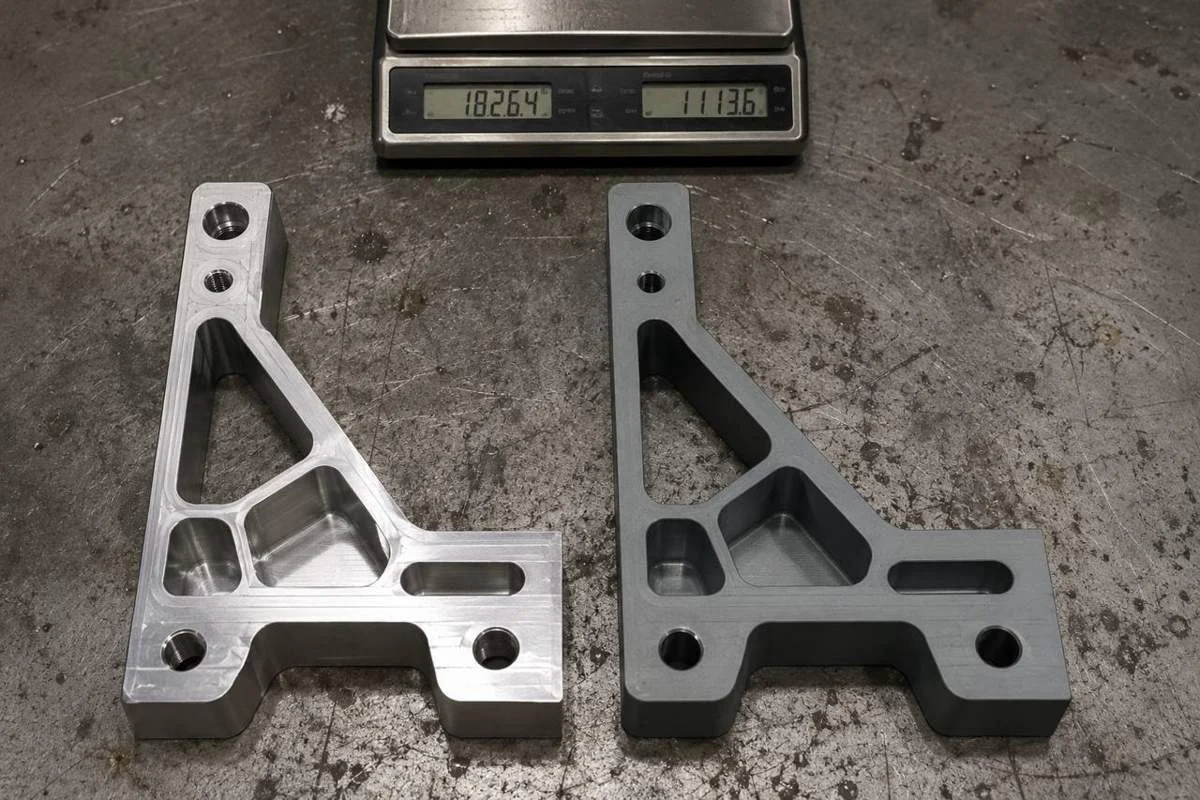
Aerospace structural parts: An aircraft bracket does not need to resist scratching. It needs to survive 20,000 flight hours at high cyclic loads without cracking, resist galvanic corrosion at fastener joints, and do both at 40% less weight than a steel equivalent. Grade 5 titanium meets all three requirements; hardened steel fails the third.
Medical implants (Grade 23 / ELI): A hip stem must resist corrosion inside the human body for decades. Surface scratches from handling during surgery are irrelevant in service. The bone-integrating surface is roughened intentionally (via sandblasting or acid etching) to promote osseointegration.
Marine hardware: A titanium through-hull fitting on a saltwater yacht will not pit or crevice-corrode, unlike 316 stainless steel, which is vulnerable to pitting in warm, stagnant seawater. Scratches from docking are cosmetic, not functional.
Chemical processing: Grade 2 titanium is the standard material for heat exchangers in chloride-rich environments where 316 stainless steel fails within months. The hardness number is not relevant; corrosion resistance is the selection criterion.
Hardness-Dependent Applications: Where Steel Wins
When hardness directly determines performance, steel remains the better choice.
Cutting tools and blades: A knife edge at HRC 58–60 will hold an edge hundreds of times longer than one at HRC 30–34. This is why premium knives use hardened tool steels (M390, S90V, CPM-S110V) rather than titanium, despite titanium’s appeal for frames and handles.
Gear teeth and bearing surfaces: Contact fatigue resistance scales with surface hardness. Hardened alloy steels (HRC 58–62) and case-hardened steels are standard for gears and bearings. Titanium is not used in rolling-element bearings.
High-wear machine parts: Wear plates, bushings, and slideways require surface hardness above HRC 50. Plain or hardened steels are the default here.
Summary: What to Remember
- Titanium Grade 5 (Ti-6Al-4V) is not hard. It sits at Rockwell C 30–34 (annealed), which is softer than most stainless steels and much softer than tool steels.
- Titanium is strong and light. Its strength-to-weight ratio exceeds that of steel, and it resists corrosion naturally.
- The numbers change with heat treatment. Always check whether a datasheet lists annealed or STA values. The gap can be 5–9 HRC points.
- Surface treatments work. Nitriding, carburizing, PVD coatings, and Expanite can raise surface hardness to HRC 60+ while preserving titanium’s bulk properties.
- Hardness is the wrong metric for many titanium applications. Corrosion resistance, fatigue life, biocompatibility, and weight are the real reasons to specify titanium.
- Steel is harder. Every time. If hardness is your primary design requirement, choose steel and save money.
FAQ
What is the Rockwell hardness of Grade 5 titanium?
Grade 5 titanium (Ti-6Al-4V) in the annealed condition is Rockwell C 30–34. After solution-treated-and-aged (STA), it increases to Rockwell C 35–39. These values are documented in the ATI datasheet and MatWeb material database.
How hard is titanium compared to steel?
Titanium Grade 5 (HRC 30–34) is significantly softer than most engineering steels. AISI 4140 in the quenched-and-tempered condition reaches HRC 38–42. Hardened tool steels exceed HRC 60. Titanium’s advantage is not hardness but its strength-to-weight ratio and corrosion resistance.
Why is titanium soft despite being strong?
Strength and hardness are different properties. Strength measures resistance to pulling forces (tension). Hardness measures resistance to surface indentation. Titanium’s crystal structure (HCP alpha, BCC beta) provides excellent tensile strength but does not resist surface deformation the way the heavily alloyed, heat-treated microstructures of tool steels do.
Can titanium be case hardened?
Yes, through surface treatments rather than bulk heat treatment. Nitriding, carburizing, and PVD coatings can raise titanium’s surface hardness from HRC 30–34 to HRC 60–70. These treatments add a hard surface layer while the bulk material retains its strength and ductility.
Why does my titanium watch scratch so easily?
Titanium watches have a surface hardness of HRC 30–34, while stainless steel watches are typically HRB 80–90 (about HRC 15–20 for annealed) — but stainless steel can be cold-worked and surface-hardened more effectively. In practice, the very thin natural TiO₂ oxide layer on titanium provides zero scratch protection, while stainless work-hardens under surface contact. Many watch brands use DLC or ceramic coatings on titanium cases to compensate.
Is titanium harder than aluminum?
Yes. Pure aluminum is about HRB 20 and HV 25. Even the softest Grade 1 titanium (HRB 70, HV 122) is substantially harder than aluminum. Grade 5 titanium (HV 349) is roughly 14 times harder than pure aluminum on the Vickers scale.
What is the Brinell hardness of titanium Grade 2?
Titanium Grade 2 has a Brinell hardness of approximately 145 HB in the annealed condition, per MatWeb. This is similar to annealed 316 stainless steel (146 HB per MatWeb), but Grade 2 is significantly lighter at 4.51 g/cm³ versus 8.0 g/cm³ for stainless steel.
Does titanium get harder over time?
Titanium does not naturally age-harden at room temperature. However, titanium alloys can be intentionally aged by heat treatment (typically 480–590 °C for several hours) to increase hardness. In service at elevated temperatures (above 300 °C), some titanium alloys may show subtle changes in properties over long exposure times, but this is not the same as “getting harder.”